Many written accounts of ‘everyday histories’ focus on prominent figures and major events. However, it is the documenting of the working class which preserves the lived experiences of ordinary people.
We are indebted to Great Ellingham man Harry Rix. In 2001, 80 year old Harry decided to record some of his boyhood memories of the village. Harry came into the world on the 1st December, 1920, in a cottage in Long Street. As far as I know, he spent most (if not all) of his life in the village.
What follows are extracts from Harry’s memoirs, collated by his daughter. In this article, Harry takes us on a ‘tour’ of many of the properties in Long Street.
Pilgrim
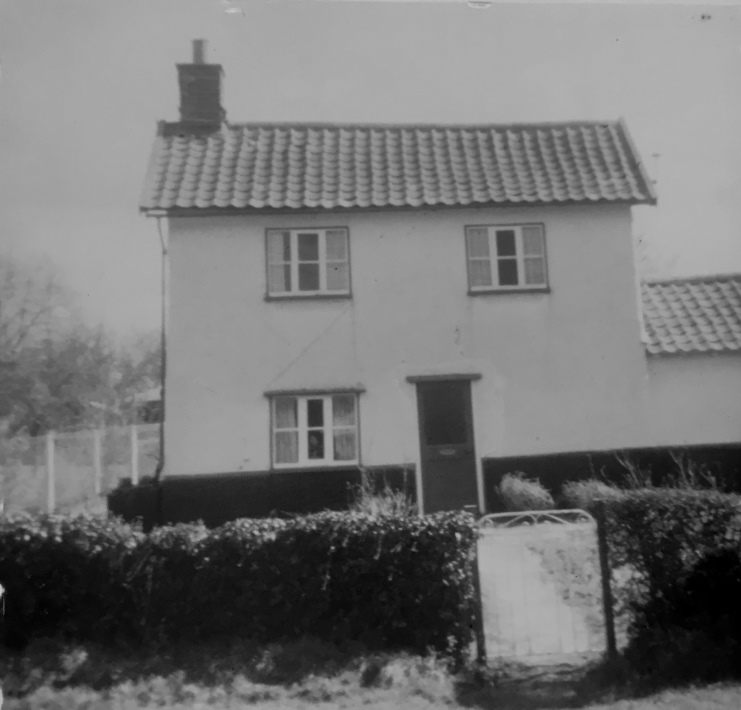
Pilgrim’s Cottage in Long Street
Photograph Ian Butler
On the east side of Long Street going south the first cottage you came to was colourwashed walls and red tiles roof, and was occupied by Mr. & Mrs. Pilgrim and a fostered boy named Palmer.
Sussams & Partridge
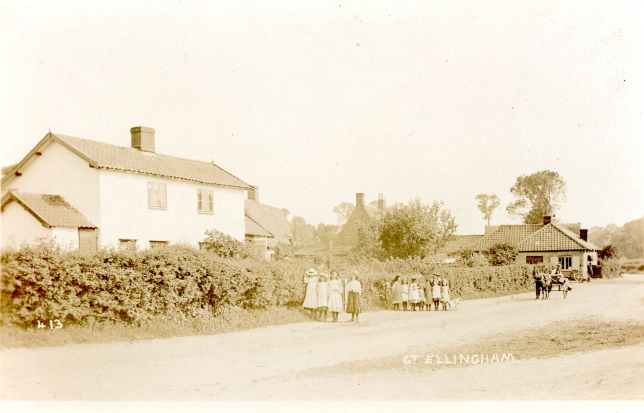
Double Cottage once occupied by Mr Sussams and the Partridge Family. Lebbell’s Smithy to the right
Next you come to a pair of cottages of similar construction to the first. The northern end was occupied by Mr. J Sussams who lived on his own. In order to provide an activity for evenings when the weather permitted, he took to attempting to play a flageolet whilst standing on his back door step. His attempt became acceptable with time!
The other end of the cottage was occupied by Mrs. Partridge. She and her husband had several children: Charles, Harry, Benjamin as well as daughters.
Giles
A small cottage previously existed which was occupied by Mr. & Mrs. Giles and their family of Stanley, Douglas, Charles as well as daughters. Mr. Giles was an agricultural worker. At the time of World War 2 Stanley was taken into the army (Cider makers Gaymers Unit) and was lost in the far East conflict.
Lebbell’s Blacksmith’s Premises
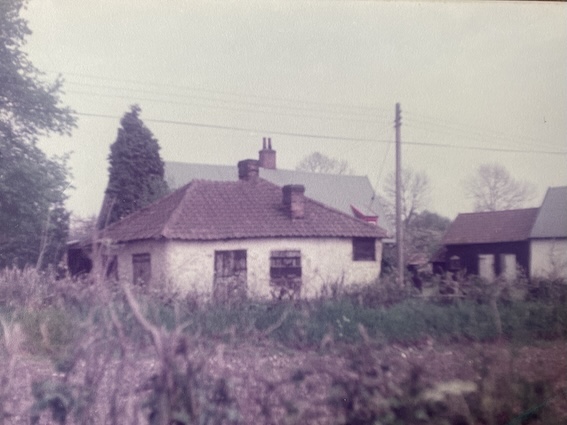
Lebbell’s Smithy in Long Street
Courtesy Elizabeth Neil.
Adjoining the cottage was a clay walled and tiled roofed blacksmith's premises, the window openings of which had wooden shutters.

The window next to Long Street had an opening formed through the wall just below its sill.  Inside the forge the smith’s hearth was at about the same level as the opening.  Mr. Lebbell, the owner, explained the reason for this arrangement which came about because of the need to weld together lengths of steel bars to be used as tie rods in the roof construction of the Wayland Hospital.

As the welds would have been ‘fire welds’ it would have been necessary for the ends of the bars to have been heated to welding temperatures for the weld length and then, without loss of time, position the bars on top of each other on an anvil and strike the heated metal with a hammer to cause the extremely hot surfaces to unite.

As Mr. Lebbell remarked to me ”To fire weld two pieces of iron together, they have to heated to the right temperature, immediately lain so that the surfaces to be welded are in contact and struck with a hammer.  It is the first hammer blow that achieves the union. If for some reason the metals are not united by the first blow, subsequent hammering will be of no effect”

Visually the scene of the smithy, iron rods would have ends to be joined laid in the forge fire, the rest of one rod would be in the smithy, the other rod would be placed similarly but at 180 degrees to the first rod, hence the hole through the wall.

This rod would be across Long Street and would have caused traffic to be diverted around Town Green whilst the work was in progress.  An anvil was probably erected outside on Long Street purposely for this work to be carried out.

Visualising the transport of the extended tie rods to Wayland Hospital, this may have required some timber drugs sufficiently long for the task.
Fuller
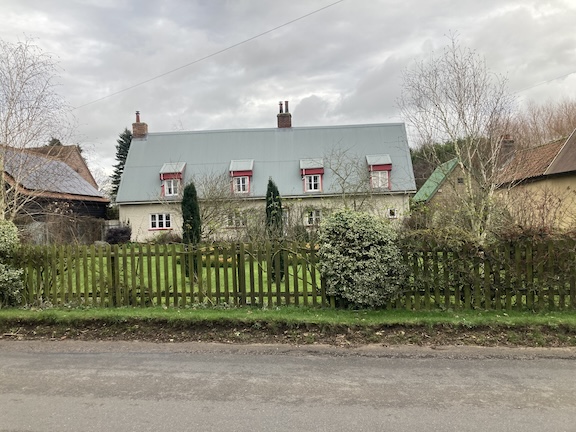
‘Grey Roofs’, Long Street. The former home of Mr & Mrs Fuller.
Photograph taken Christmas Day 2023
Next to the Smithy is a farmhouse built with wattle & daub filled timber framed walls & thatched roof. It was occupied by Mr. & Mrs. Fuller & their son Eric. Shortly after the Fullers took up residence the roof of the house was given a corrugated weather cap, the thatch being retained under the new covering.
Palgrave
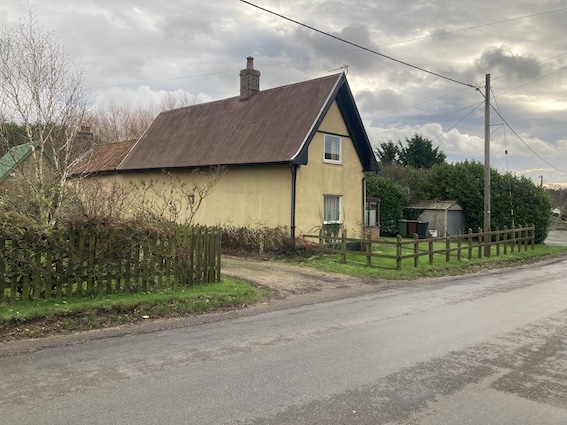
Long Street dwelling once the home of the Palgraves
Photograph taken 25 December 2023
Continuing down Long Street past the house we come to an 'endwise to road' cottage, which would seem to indicate some previous connection with the preceding property, it’s style & construction features are similar. The dwelling was occupied by Mr & Mrs E Palgrave.
Rix
A brick tiled roof bungalow is next along the road. This is not as old as most of the other premises but is older than many of the brick & tiles dwellings. Called 'Ashby' it is occupied by Mr & Mrs George H Rix.
Catling & Kittle
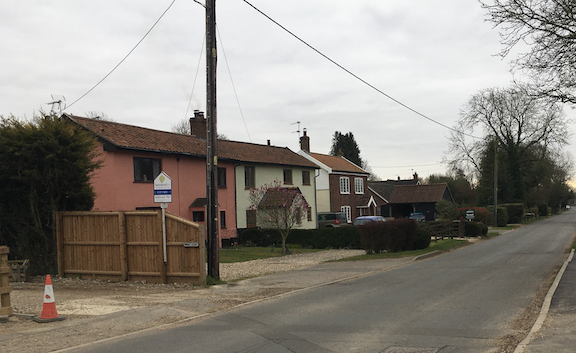
Left in the photograph is the pair of cottages once occupied by Catling and Kittle.
Further along is the detached property once occupied by Mr Dove.
Photograph taken April 2020
Next you come to a pair of cottages of similar construction to other cottages in Long Street. The northern cottage was occupied by Mr. & Mrs. Catling & two daughters. The southern cottage was occupied by Mr. & Mrs. C Kittle & one daughter.
Dove
The next cottage was occupied by Mr. W Dove (senior).
Beales
Harry then takes us past some gardens and orchard and then to Bankfield Bungalow.
'Bankfield Bungalow' was more recent than most properties. It was built for Mr. & Mrs. E.W. Beales of brick & tile construction.
Lebbell
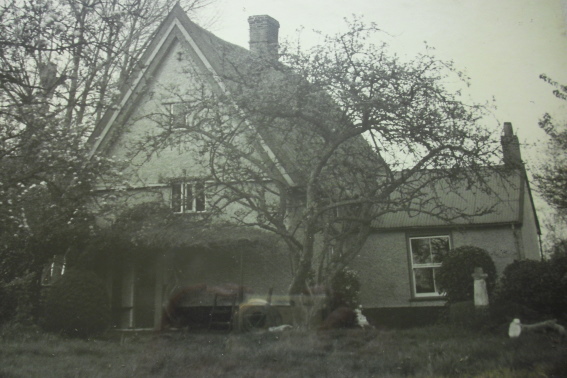
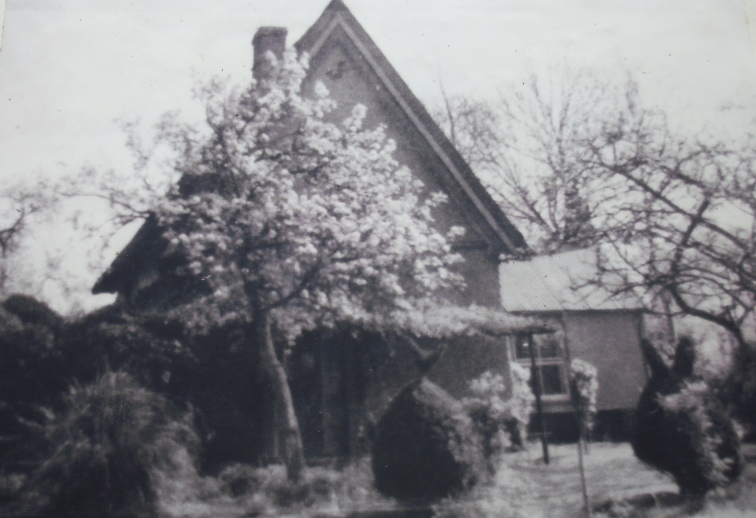
Poplar Farm. Once the home of William Lebbell & his family
Courtesy Sue Fay
Poplar Farm has colour-washed clay walls, a thatched roof with some later extension.  Occupied by Mr. William Lebbell, his wife, sons & daughter.

Mr. Lebbell told of how he received a small honorarium from the Parish Council when was pensioned off from his post of collector of rates when that duty was taken over by the District Council.

He also told that being a man with a deformed back he was 'grade C3 medically' at the time of World War 1.  He also farmed some land but the military called him up to do non combatant duties.  Shortly after having been called to serve, the government said that women left to carry out farming by the calling up of their husbands could apply for a 'C3 grade soldier' to help on the farm, that is what Mrs. Lebbel did.

When her soldier arrived it was her husband who had the job of running his own farm with army assistance!
Baptist Chapel
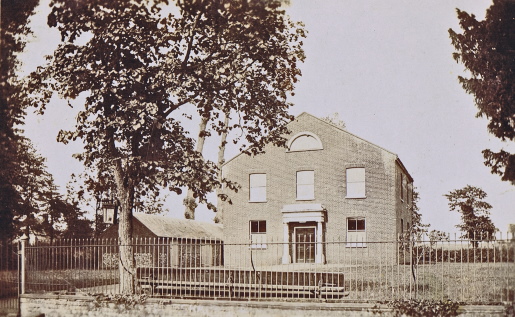
Baptist Chapel Long Street Great Ellingham
Attleborough Heritage Group
Next is the Baptist Chapel. This is a large red brick and tiled building standing in a fair sized plot. It is said to be one of the oldest Baptist Chapels in England. It has facilities for the baptismal rite of full immersion.
Clifford
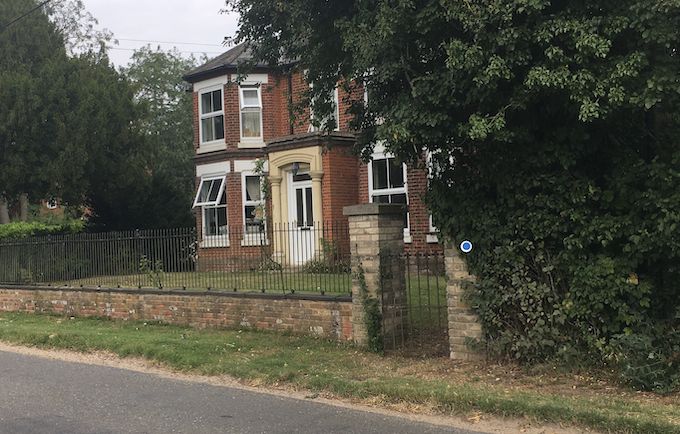
There is a Manse building of brick with slated roof and is used by the Pastor. The writer remembers a Pastor names Clifford who was followed by other occupancies before another Pastor Reverend Doctor Clifford came with his family to live in the Manse.
Fox
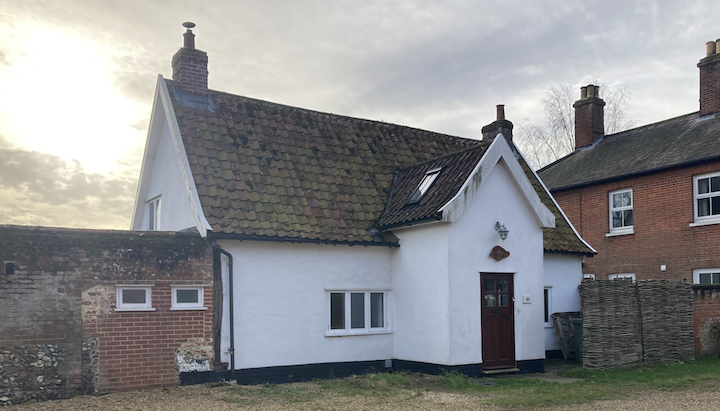
The cottage behind the Manse once occupied by Mr & Mrs Fox.
Photograph taken November 2024
Behind the Manse is a clay lump & tile roof building lived in by Mr & Mrs Fox and their family.
Witton
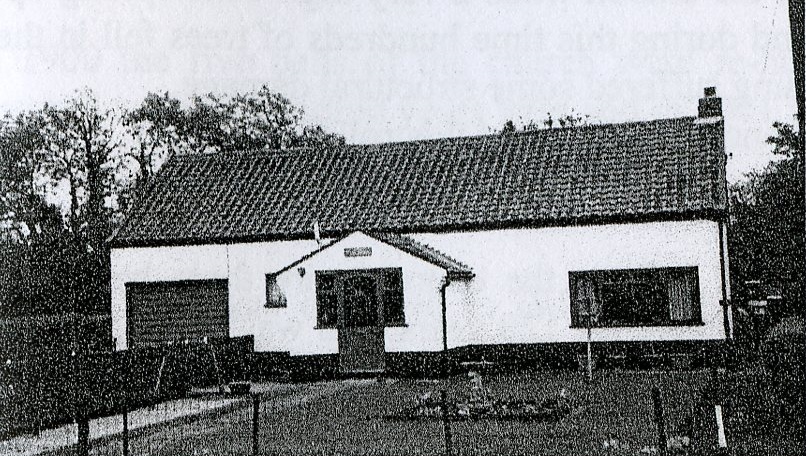
Mr & Mrs Witton’s bungalow in Long Street. The dwelling once housed the former British School
Courtesy Sue Fay
Next to the Manse a brick & tiles roof bungalow understood top have formerly been the village school before the Board School was built. My memory recalls that Mr Witton the owner was busy with conversion work in about 1926, although there may have been work carried out in the building when is was displaced as a school by the Board School in 1896.
Rix & Leeder

Left is the bungalow once occupied by Mr & Mrs Witton. Next along are the two pairs of cottages
Courtesy Georgina Wing
The next dwellings southwards is a pair of cottages of clay lump walls & tiled roof construction, the northern part being once occupied by Mr & Mrs Rix & their son [Harry himself]. The southern part occupied by Mrs Leeder.
Ames & Drewry
The next building is a similar pair of cottages to the last. The northern part occupied by Mr J Ames. The southern part occupied by Mrs F Drewry.
Public Footpath to the Baptist Cemetery & Attleborough Road
After about 50 yards southwards a public footpath leads in a NW direction to the Baptist Cemetery and the Attleborough road.
Nichols & Lincoln
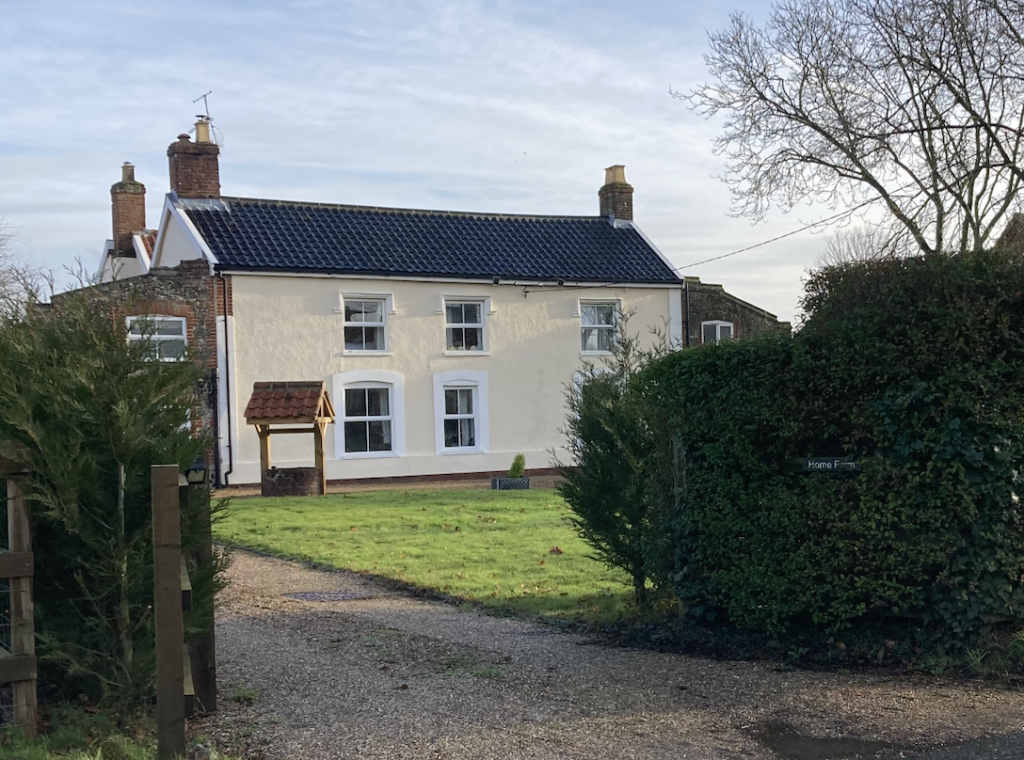
Home Farm formerly known as Cemetery Farm, once the home of Alan Lincoln and Mrs Nichols.
Photograph taken January 2026
About another 80 yards southwards from the public footpath we reach Cemetery Farm (now known as Home Farm). The farmhouse and the farm buildings are clay lump & flint walled with tiled roofs.
The house is occupied by Mrs Nichols and Mr Alan Lincoln. Mr Lincoln has the misfortune to need an invalid chair to enable him to get about by his own efforts.  He does manage to get to the village church, weather permitting.

One of the barns just after the house ran alongside the road, where Bandit Lodge now stands. In the wall of the barn there was set a post box which was still being used for post in the 1970s.
Mallett, Carter, Kittle & Others
Adjoining Cemetery Farm are clay walled and tiled roofed cottages details of occupiers are lost but did include the families Mallett, Carter and possibly two others.

There was also a simple single storey bungalow of similar construction occupied by Mrs Kittle.
Shanks
A holding is located at about the bend in Long Street and comprises a house and farm buildings. It is believed the occupiers are Mr & Mrs Shanks.
Harper, Jackson, Crawford

Fir Tree Farm, Long Street. June 1989
Courtesy Margaret Smith
The next dwelling (with agricultural buildings), clay lump walls slate & tile roof.  Occupied by Mrs E Harper, school teacher and organist at the village church. She has adult daughters.

Miss Jackson, Mrs Harper's sister lives with Mrs Harper.  Mr Crawford deals with agricultural & farming matters.
Sadd
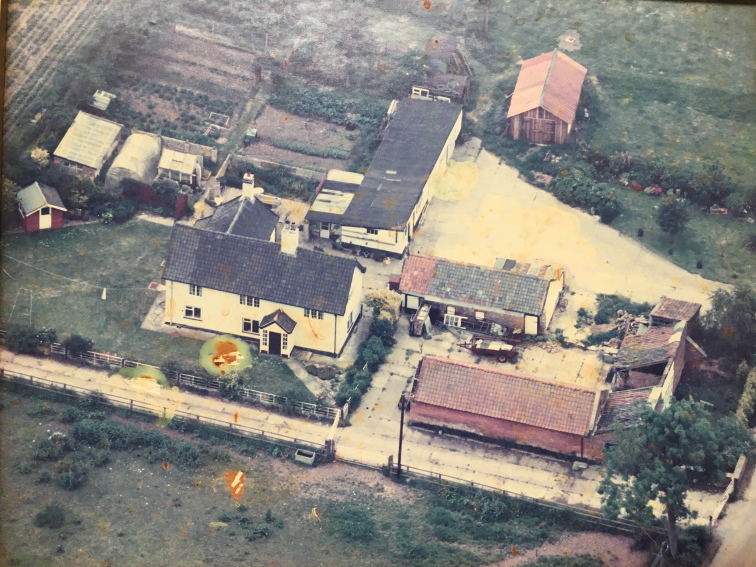
White House Farm, Long Street, Great Ellingham
Courtesy Justin Wilkins
Grassland of about 3 acres on the southside is abutted by Whitehouse Farm.  The farm in the usual construction of clay lump walls & tiled roof.  A large barn is occupied by the James Sadd family of father sons & daughters including twins (boy & girl).

The farmyard runs beside Shrugs Lane on the south side.  This lane gives an access through to the Attleborough to Watton Road.
Fox
A hundred yards south of Whitehouse Farm stands a dwelling called 'Sparrows Nest' built from studwork and wattle & daub walls and thatched roof. It is occupied by Mrs [Fox?]
Wheeler
A further 100 yards from Sparrows Nest along Long Street is a more modern bungalow built for Mr D Wheeler. This was built at an intermediate time between the older properties and recent development and is called 'Two Oaks'.
Jackson
Adjacent to Two Oaks is a house built with brick walls and tiled roof this is occupied by Mrs Jackson, who has a son who is usually referred to as Sonny.
Continuing along Long Street we come to the river that is the Parish Boundary and also the main course which provided drainage to Great Ellingham.
Harry takes us back to the northern end of Long Street …..
Returning to the point near Great Ellingham Post Office where Long Street commences and, transversing in the offside of the street past the triangle of land which is generally know as Town Green.
Fellows
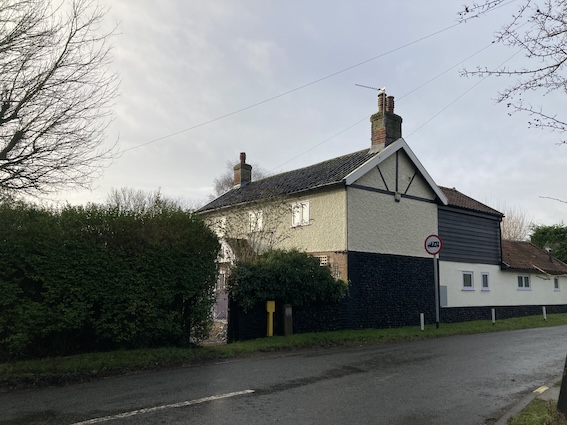
Photograph taken January 2026
We come to Penhill Road (sometimes known as Penhill Lane).  On the south side is a clay-walled and pantile roofed cottage which has a front garden, and at the abutment of which to Long Street, is a running water ditch.

Mr Fellows & his wife live in the cottage and use the land belonging there to use as a smallholding.  Mr Fellows makes use of the ditch as a watering place for his little flock of ducks.  In the summer time he can be seen tending them when he is wearing his white shirt and dungarees supported by wide strap type braces which give him the nickname of red braces.  This cottage may be called Redlands.
Wildgoose
Continuing along Long Street a house of more recent construction is situated about 100 yards from Redlands, and is set well back from the public road. It is built with fletton brick walls and pan tiled roof. The bricks have a face pattern which gives them the name ‘crinkles’ bricks. The occupier is Mr S Wildgoose(?) one time occupier of the Old Hall Farm, and a greyhound dog racing buff.
Gardener & Another
Onwards another 50-60 yards is a pair of clay walled and tiled roof cottages occupied by Mr & Mrs R Gardener and Mr [?].
Hutson
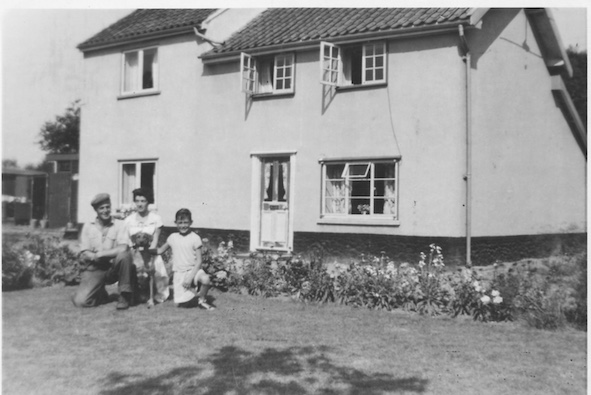
‘Southview’ Long Street
Courtesy Alan Gardiner
A further 150 yards a collection is call walled and tile roofed buildings one sees. The dwelling part is occupied Mr Alan Hutson & his wife. Property has been called 'South View'.
Bird
Another 50 yards along Long Street another cottage is reached.  Occupied by Mrs Bird.

One occurrence which took place to the property came about due to the narrowness of Long Street and the presence of deep sides drainage ditches at each side of the roads together with the presence of an overhead electricity cable supported by a pole system on the opposite side of the road.

From one of the poles overhead electricity service was taken into the cottage and attached to the chimney.  Two large cattle float vehicles tried to pass each other next to the cottage, one made it safely the other vehicle stopped for this to happen and whilst stationary the brow of the ditch slowly subsided allowing the cattle float to come into contact with the electricity cable support pole which under pressure leaned over and put tension on the service cable which was attached to the cottage chimney.

Part of the chimney above the roof line gently slid over and rested halfway down the tiled slope.
At this point, Harry’s recollections come to an end. I do not know whether he intended to continue the ‘tour’ of Long Street and the rest of the village. Sadly he became ill not long after writing these memoirs. He left us with a great snapshot of some of the streets in the village in times gone by.
In other articles, Harry takes us along Attleborough Road, Chequers Lane and Church Street.
Source:
‘Early Boyhood Recollections of a Great Ellingham by an Octogenarian’ Harry Rix. Huge thanks to Elizabeth Neil.