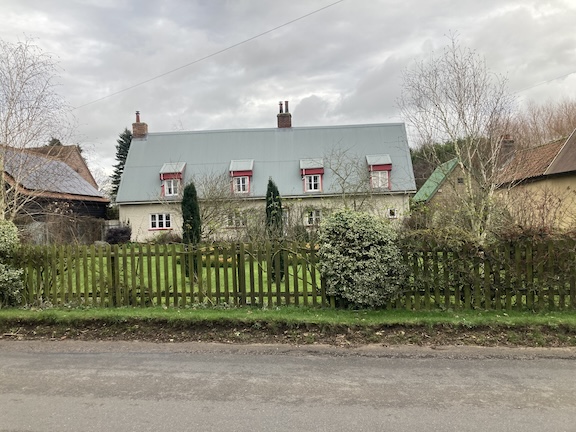
Grey Roofs, Long Street. Photograph taken Christmas Day 2023
Norfolk Heritage Explorer website describes the Grade II listed building known as ‘Grey Roofs’ as
House. Early C18. Timber framed with lath and plaster infill, roughcast. Corrugated iron roof. Lobby entrance plan. One storey and dormer attic. Door in centre. Three three-light C20 casements. Four sloping dormers with casements. Gabled roof. Stack over door rebuilt. North bay added in late C19 with internal gable stack.
The house became ‘listed’ in November 1983. It was probably not until the 20th century that the house took the name ‘Grey Roofs’. Nonetheless, and for ease of reference, I refer to the property as Grey Roofs whether or not it was actually known by that name at the time.
Over the centuries, Grey Roofs has been the home of many families. At various times the building would have been divided into two (or even three) dwellings. Today it is just one dwelling.
Copyhold Land
Without the sight of any deeds, it can be challenging to piece together a ‘house history’. Deeds will confirm the owners or lenders at various times. Further, the names of the occupiers may appear in conveyancing deeds.
Nevertheless, it is sometimes possible to put together a potted history using manorial records. Although at the time of the Great Ellingham Inclosures c.1800, it appears that ‘Grey Roofs’ was not copyhold, several pieces of land ‘belonging’ to Grey Roofs are.
If we can be reasonably confident that some (if not all) of the copyhold land is owned by those individuals who also owned Greyroofs, then the manorial records for Buckenham Castle Outsoken and Attleburgh Mortimers, provide us with an unbroken chain of ownership.
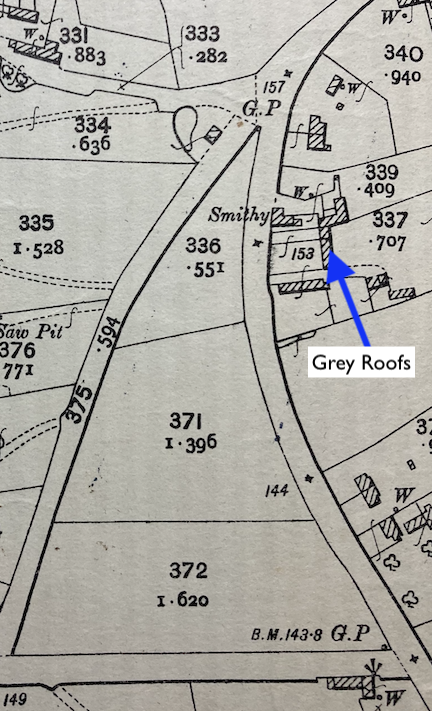
Extract from 1906 Ordnance Survey Map. Second Edition. Surveyed in 1881. Revised 1904.
Norfolk Heritage Explorer website suggests that Grey Roofs dates from the early 18th century. However, I do not know exactly when it was built.
As I mention, this potted history is put together using the manorial records relating to the copyhold land which I know to be owned by the same owner as Grey Roofs in the late 18th century and early 19th century.
| Approximate Dates | Owners and/or Occupiers |
|---|---|
| 1686 | Jeffrey Warren ‘took up’ the copyhold land from Jeffrey Warren. Did this also include Grey Roofs? Their son, John Warren, was baptised in St James’s Church, Great Ellingham on the 1st January, 1672. According to an Inventory in connection with his will 1694-1696, Geoffrey Warren is a woolcomber of Great Ellingham. I do not know whether Grey Roofs existed at this time. |
| 1686-1696 | Jeffrey Warren and his wife Mary are both deceased by 1696. |
| 1696-Bef. 1732 | It is at this time that John Warren (baptised 1672) ‘took up’ the copyhold land. Again, did this also include ‘Grey Roofs’? John Warren died before January 1732. |
| 1732-1754 | His daughter Mary Warren (then the wife of Edward Turner) inherits her father’s land and property. I presume that this includes Grey Roofs. However, this inheritance is limited to her lifetime. After Mary’s death, John Warren instructs his executors to sell his property. Mary Turner’s will is dated 6th January, 1754. She dies before 14th October, 1754. |
| 1754-1755 | The estate of the late John Warren is held by his executors and trustees, viz. John Barnard, carpenter of Great Ellingham and William Turner, the son of Edward & Mary Turner. |
| 1755-1779 | John Barnard & William Turner (as executors of the late John Warren), sell to Jane Ripper. An Indenture of Bargain & Sale dated 2nd October, 1755, made between (1) John Barnard & William Turner (2) Mary Ripper, widow of Attleborough and (3) Jane Ripper, described as the granddaughter of William Ripper, is produced at the manorial court of Attleborough Mortimers on the part of Poynants. Jane Ripper is admitted as a copyhold tenant of that Manor on the 5th April 1756. I suspect that Jane Ripper was a ‘minor’ at that time. She may well be the Jane Ripper, daughter of John & Ursula Ripper, who was baptised in St Mary’s Church.. Attleborough on the 19th May, 1746. The property may have been purchased following the death of her grandfather as an investment for Jane’s own benefit but this is little more than a guess. On the 19th January, 1765, Jane Ripper marries Thomas King at St Mary’s Church, Attleborough. Two known sons, John and Thomas, are baptised in St James’s Church, Great Ellingham on the 22nd September 1766 and 2nd November 1767 respectively. Thomas and Jane King lived at nearby Mill Farmhouse. However, I feel sure that the couple continued to own Grey Roofs. Jane King is buried in the churchyard at Great Ellingham on the 9th November, 1779. |
| 1779-1791 | John King inherits his mother’s property as her ‘only son & heir’. The Manor Court books for Attleburgh Mortimers on the part of Poynants, mention that John King is aged 14 & upwards (in 1781). On the 14th November, 1788, 22 year old John King enters into a Mortgage Deed with John Towler, a farmer, of Rockland All Saints. The Deed secures the sum of £250 plus interest. The Manor Court Books for both Attleburgh Mortimers and Buckenham Castle Outsoken for 25th and 27th October 1791 respectively, refer to an ‘unconditional surrender’ of copyhold land by John King and his wife Rebecca to John Towler. I have no doubt that it was also at this time that John King conveyed his freehold property Grey Roofs to John Towler. |
| 1791-1821 | We know from the Great Ellingham Inclosure Documentation c.1800 that John Towler owned a Tan Office & yard (off Long Street) which he let to Thomas King. He also owned Grey Roofs which is occupied by Jeffrey Towler. John Towler also owned and occupied various pieces of land near to Grey Roofs and the Tan Office. John Towler died before the 12th March, 1821. His will is dated 7th August, 1820. In his will, John Towler states “I do give and devise unto Mary Warren my daughter for and during the term of her natural life ALL THAT my messuage or farm house …. together with all lands belonging to the same and now in the occupation of John Warren in Great Ellingham, she my said daughter keeping the same premises in good and tenantable repair ….” A survey of Great Ellingham 1817-1819 shows that John Warren did indeed occupy much (if not all) of his father-in-law’s land off Long Street as well as Grey Roofs. At this time, there is also a cottage and garden very near to Grey Roofs. The survey gives the occupiers of the house and cottage as John Warren, James Lebbell, Samuel Pitts. John Morphew may have been an earlier occupier. I believe that the cottage adjoined the northern end of Grey Roofs. Later, James Lebbell’s son, Robert Lebbell, had his blacksmith’s shop near to the cottage. However, there was an earlier blacksmith’s shop occupied by the Lebbell family on Town Green. The ‘Smithy’ would remain in the occupation of the Lebbell family for many years. |
| 1821-1842 | Following John Towler’s death, his daughter Mary Warren (the wife of John Warren) became the owner of Grey Roofs. Her father stipulated in his will that Mary must not mortgage or sell the property. Her ownership is, of course, limited to her lifetime. Mary Warren died before March 1842. |
| 1842-1843 | The Great Ellingham Tithe documentation of December 1843, shows that John Warren occupied various pieces of land near to Grey Roofs, which included the site of the former Tan Office & Yard. At that time, Grey Roofs is occupied by ‘Alice Lebbell & others’. Alice is the widow of the former blacksmith, James Lebbell. This may well include the cottage to the northern end of Grey Roofs. Grey Roofs and the land is held by Mary Warren’s executors. Following the death of Mary Warren, the ownership of Grey Roofs and the associated land, passed to the six children of Mary Warren in accordance with the will of the late John Towler (their maternal grandfather). The children are: – Mary Rivett, the wife of Jonathan Rivett of Great Ellingham, farmer & fowlman – John Warren, the Younger, of Great Ellingham – Jane Bartram, the wife of John Bartram of Great Ellingham, farmer & butcher – Elizabeth Warren, of Great Ellingham, spinster – Rebecca Warren, of Great Ellingham, spinster – Sarah Ann Warren, of Great Ellingham, spinster |
| 1843-1897 | In April 1843, John Warren, the Younger’, came to an agreement with his siblings to ‘buy out’ their respective shares in Grey Roofs and some 22 acres of land. The consideration was £358. Earlier, on the 16th February, 1843, John Warren had married Elizabeth Chaplin in Little Ellingham. On the 29th July, 1843, some three months after purchasing Grey Roofs and the land from his siblings, John Warren mortgages all his property and lands to surgeon, John Brownfield, of the City of Norwich. The mortgage secured a loan of £600 with interest at the rate of £4 per cent per annum. I do not know whether John and Elizabeth Warren ever lived together at Grey Roofs. |
| The 1851 census finds 36 year old farmer John Warren with his wife Elizabeth 33 and their children Daniel 7, Mary 6, John 4 and Henry 2 living in Church Street, Little Ellingham. Young Daniel Warren had already inherited the property in Church Street, Great Ellingham (later known as ‘Ye Olde Thatche Shoppe’), from his Great Uncle Daniel Cocking. I feel sure that John Warren (of Little Ellingham), continued to own Grey Roofs until his death in April, 1897. Accordingly, the property would have been let to tenants. I have yet to find out the names of the tenants! |
Sources:
Manor of Attleborough Mortimers Manorial Court Rolls 1641-1930 [Mortimers with Members Manor; 1189-1925, Attleborough, Norfolk.] Norfolk Record Office
Manorial Court Rolls for Lathes, Close, Castle & Buckenham Priory 1595-1847. Norfolk Record Office
Viewed via www.familysearch.org
Attleborough Parish Registers. Norfolk Record Office PD 438. Norfolk Record Office. Viewed via www.ancestry.co.uk
1800 Inclosure Commissioner’s Particulars and Valuation. Great Ellingham. Norfolk Record Office MC2213/119
F.W. Horner, Records of the Surveyors to Commissioners for Inclosure in Parishes in Norfolk & Suffolk. 1799-1842. Great Ellingham (Act 1799). Norfolk Record Office. Catalogue Ref BR 90/2
1802 Map of Great Ellingham. Russell James Colman Plans. Norfolk Record Office. Catalogue Ref. C/Ca 1/84
1799 Statement of Claims. Great Ellingham Inclosure. Norfolk Record Office. Cat. Ref: MC 2213/118
Great Ellingham Tithe Map 1843. Tithe Apportionments, 1836-1929 [database online]. TheGenealogist.co.uk 2023. Original data: “IR29 Tithe Commission and successors: Tithe Apportionments” The National Archives
Little Ellingham Parish Registers. Norfolk Record Office PD 568/5. Viewed via www.ancestry.co.uk
1851 census HO107/1823/138