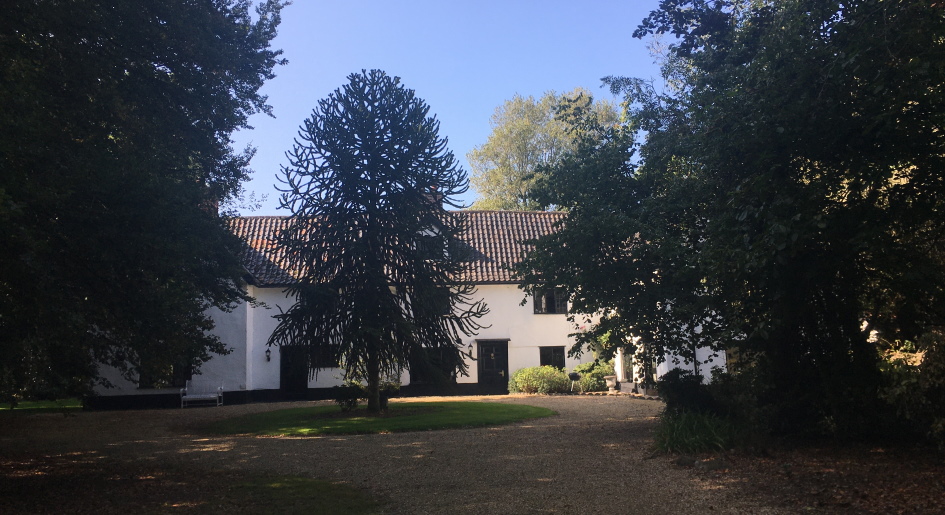
Great Ellingham Hall
Photograph taken September 2020
Ancient Moated Farm House
White’s Directory of 1864 refers to ‘The Hall’ at Great Ellingham as “an ancient moated farm house, formerly the seat of Sir Roger Potts, Kt., is now the residence and property of Benj. Barnard, Esq., on whose estate a remarkably fine stone celt and a brass battle-axe, were discovered some years ago”.
Manors of Great Ellingham
The directory also tells us that Walsingham is the Lord of the Manor of Bury Hall, which is said to be the largest of the three Manors in Great Ellingham. Thomas Lombe Taylor Esq., is the lord of the Manors of Ellingham Hall and Ellingham Rectory. However in earlier times, the Manor of Ellingham Hall was larger than the Manor of Bury Hall.
Until around 1825, the lordship to the Manor of Ellingham Hall was held by owner of Great Ellingham Hall. Further, at some point before 1743, the Manor of Ellingham Rectory came into the same ownership.
Early History
In other articles, we have looked at the very early history of the Manor of Ellingham Hall. We discovered that Anthony Gurney (died 1555) began a re-build of Great Ellingham Hall. His grandson, Henry Gurney (1548-1615), continued his grandfather’s work, as well as making further changes to the property.
As it happens (and like many other gentry families), the Gurneys ran out of a direct male heir. Accordingly, the ownership of Ellingham Manor and Great Ellingham Hall came to the Davy family (of Great Ellingham) and then, by way of marriage, to Sir Roger Potts (1642-1711).
Here we take the history forward from 1712 when the property and the manor were purchased by Francis Coleman.
New Owner Francis Coleman
In September, 1712 Francis Coleman completed his purchase of ‘the Great Ellingham estate’ from the Potts family. The Conveyance Deed of 1712 describes Francis Coleman as a gentleman of Bramfield in Suffolk.
It follows that Francis Coleman had independent wealth and was high in the social standing. However, his position in society was slightly below that of Sir Roger Potts!
Coleman paid £4,310 for the Great Ellingham estate.
I can only assume that Francis Coleman moved into Great Ellingham Hall.
Sale Off
Later in 1712, Francis Coleman sold a Sheppards House and various parcels of land in Great Ellingham to Thomas de Grey, Esq., the lord of the Manor of Bury Hall. Two years later, he sold further land to de Grey.
Marriage?
Not long after he completed his purchase of the ‘Great Ellingham estate’, Francis Coleman entered into a Lease and Release (conveyances) on the 8th and 9th September, 1712, with Elizabeth Rutter, a widow of Norwich and ‘others’.
The deeds describe Francis as a gentleman of Bramfield, Suffolk. I have no more details of the transaction as I have yet to investigate these particular deeds (NRO WAL1604/4).
Settlement or Mortgage?
It is possible that Francis Coleman either mortgaged his ‘Great Ellingham estate’ or (and I think more likely), he ‘settled’ the estate on an intended marriage to widow Elizabeth Rutter. His bride may well have brought money or property (or both) to the marriage.
Unfortunately, I have not found evidence of a marriage between Francis Coleman and Elizabeth Rutter – or the death of this first ‘Elizabeth Coleman’ (if indeed Francis married Elizabeth Rutter).
Marriage to Elizabeth Fisher
Nevertheless by 1720, Francis Coleman is widowed. He is also planning to re-marry.
On the 31st May, 1720, Francis Coleman, a gentleman, of Great Ellingham enters into a ‘Marriage Settlement’. His bride (and also a party to the deed) is spinster Elizabeth Fisher.
She is one of the daughters of the late Robert Fisher, a gentleman of Grantham, Lincolnshire. Also party to the deed are Robert Fisher B.A. of Christchurch, Oxford and Nicholas Harmer, an ironmonger, of Norwich.
The deeds recite that Elizabeth Fisher’s portion (her dowry) of £2,000 is paid to Francis Coleman by her uncle, Sampson Estwick, the Rector of the parish of St Michael Queenhill (Queenhithe), London.
Marriage Settlement of the ‘Great Ellingham Estate’
Francis Coleman brought to the marriage:
- The manor or lordship of Great Ellingham with all the profits etc.
- The capital messuage called Great Ellingham Hall, all other houses, outhouses, buildings barns, stables, dovehouse, yards, garden, orchards and the land, meadows, pastures, feedings, commons, shacks, sheep’s course, sheep’s walk, foldages, woods etc and all the appurtenances to the manor and lordship in Great Ellingham, Little Ellingham, Rocklands, Attleborough, Deopham, Hardingham and Morley.
- All those messuages, lands, tenements and hereditaments in Great Ellingham which Francis Coleman had ‘lately purchased of John Turner, Thomas Lockwood and Robert Kidall.
Occupiers of the Estate Properties
I have no doubt that Francis Coleman lived at Great Ellingham Hall.
The names of the occupiers of Coleman’s other estate properties around this time are Ralph Cockell, Thomas Ellis, William Barnard, widow Webster, Christopher Branchflower, Henry Turner, James Can, Robert Stepney, Edward Gockin and the widow Stalham.
Trust
The trust set out in the marriage settlement benefits Francis Coleman for the term of his ‘natural life’. Thereafter the trust benefits Elizabeth Fisher in her widowhood, and then for their first son or, in default, every other son or sons of the couple (reverting to Francis Coleman and his heirs and assigns in default).
Marriage Bond & Licence
With the Marriage Settlement ‘tied up’, Francis Colman entered into a marriage bond on the 1st June, 1720. The bond was used to obtain a marriage licence.
A marriage licence was often obtained where a couple wanted to marry in haste (and not wait the three week period for the banns). It was also a means to keep the forthcoming marriage private. The more wealthy of society tended to obtain a licence to show social standing.
The bond tells us that Francis Colman of Great Ellingham, widower, intends to marry 30 year old spinster Elizabeth Fisher of the parish of St Peter Paul’s Wharf, London. The couple plan to marry in the parish church of St Michael Queenhill (Queenhithe), where her uncle Sampson Estwick is the Rector.
I assume that following the marriage, Francis and Elizabeth Coleman also made their home at Great Ellingham Hall.
Son, Fysher Colman
On the 7th May, 1722, their son Fysher Colman was baptised in the parish church at Great Ellingham. Fysher may well have spent his early years at The Hall. It is possible that he was educated at home, but this is little more than a guess.
In any event at the age of 15, Fysher left Great Ellingham and enrolled at Oriel College, Oxford on the 13th December, 1737. Later in 1741, he was awarded a B.A.
Appointment of Sheriff
In November 1741, Francis Coleman of Great Ellingham was appointed as one of two Sheriffs in Norfolk for 1742 in relation to the Court of Exchequer.
Daughter, Elizabeth Coleman
Francis Coleman also had a daughter, Elizabeth. However, I do not know when or where Elizabeth was born, and whether she is older or younger than Fysher. If older, Elizabeth may well have been from Francis Coleman’s first marriage.
Death of Francis’s wife Elizabeth
Elizabeth Coleman (nèe Fisher) died in her 62nd year on the 7th September, 1742 .
Fysher’s Marriage
As far as I know, Fysher was Francis and Elizabeth Coleman’s only son and heir.
When Fysher reached the age of 21, a marriage was arranged with Margaretta Maria Howman. I do not know whether this was actually an ‘arranged’ marriage or a marriage of choice.
By this time, the spelling of ‘Coleman’ is becoming increasing recorded as ‘Colman’.
Margaretta Maria was the daughter of Edward Howman and his wife Margaret nèe Palgrave. She was baptised in the parish church of St Peter Mancroft, Norwich on the 27th September, 1716. Accordingly, Margaretta was some 6 years older than Fysher.
Marriage Settlement
Once again, the Manor of Ellingham Hall with all the ‘estate properties’ were ‘settled’ on a forthcoming marriage.
Marriage settlements were legally binding contracts among families. Usually completed before the marriage, they provide for the management of property and land, and provide security for the couple and their children. The settlements often protected the bride’s portion (dowry) and set up ‘jointures’ for her livelihood. It was also a way of ensuring that land and property stayed within the family line.
The marriage settlement upon the union of Fysher Colman and Margaretta Maria Howman is dated 2nd July, 1743. At this time, George II is on the British throne.
Parties to the Deed
The parties to the Marriage Settlement are Francis Colman Esq., of Great Ellingham & his son and heir apparent, Fysher Colman of the first part; Edward Howman of the City of Norwich, Doctor of Physick and Margaretta Maria Howman, spinster, daughter of Edward Howman of the second part, and Robert Fysher of Oriel College, Oxford, Bachelor of Physick and Nicholas Harmer, gent., of Swafield, Norfolk of the third part.
Robert Fysher and Nicholas Harmer are almost certainly the same trustees as in Francis Coleman’s own marriage settlement of the 31st May, 1720.
Marriage Portion & the Great Ellingham Estate
Margaretta’s marriage ‘portion’ is £3,500. Fysher Colman brings to the marriage:
- the Manor of Great Ellingham
- the Manor of Great Ellingham Rectory (an acquisition by Francis Colman since 1720)
- the messuage and farm called Ellingham Hall then in the occupation of Layer Vynne
- all that messuage with the lands in (Great) Ellingham then in the occupation of William Barnard
- all that messuage and lands in (Great) Ellingham then in the occupation of Thomas Thurlow
- all those parcels of land then in the occupation of William Ripper
- all that tenement and land in (Great) Ellingham then in the occupation of Stephen Hammond
- all that parcel of land called the Bull Meadow in (Great) Ellingham in the occupation of ________Howard
- and all other the messuages, tenements, farms and lands in (Great) Ellingham then in the several occupations of Jno. Barnard, Edmund Chaplin, Simon Warren, _____ Gascoigne, _____ Ebbetts, _____ Veal, _____ Minns and _____ Turner
- and all other messuages lands etc of Francis Colman and Fysher Colman
The deed refers to Francis Colman as being of Great Ellingham. However, the Hall (with the associated farm) is occupied by Layer Vynne. Fysher Colman is probably living in Norwich.
The ‘Ellingham estate’ is also recorded as
The Manor of Great Ellingham otherwise Ellingham, 5 messuages, 2 cottages, 4 gardens, 4 orchards, 200 acres of land, 50 acres of meadow, 10 acres of pasture, 20 acres of woods, 100 acres of furze & heath, 20 acres of marsh, 'view of frankpledge' and common pasture for all manner of cattle in Great Ellingham, Little Ellingham, Attleborough, Rockland All Saints, Rockland St Peter, Deopham, Hardingham and Morley
Trust
The trust set out in the marriage settlement provides that the rents and profits etc from the trust property (i.e. the Ellingham Estate and the two manors), will benefit Fysher Colman as soon as the marriage takes place and for his lifetime.
After his death, the trust will benefit his wife Margaretta Maria. After her death, it will benefit their first born son, defaulting to second or third or fourth son, and so on. However, it does include daughter or daughters, should there be no male heir.
However, should Fysher Colman leave no heirs, then the trust reverts back to ‘the use of’ Francis Colman and his heirs forever.
Caister St Edmund
With all the ‘legalities’ finalised, Fysher Colman marries Margaretta Maria Howman in the parish church of Caistor St Edmund on the 6th July, 1743.
The marriage was reported in the Ipswich Journal on Saturday 16th July, 1743
“Last Tuesday Fisher Colman Esq., of Great Ellingham in Norfolk, was married at Castor [sic] Church, by the Rev. Mr Manlove, to Miss Howman, of the City of Norwich, an agreeable young Lady, with a large Fortune”
I do not know whether the couple lived at Great Ellingham Hall immediately after their marriage.
Elizabeth’s Marriage
Just weeks later, Fysher’s sister Elizabeth Coleman married attorney-at-law Daniel Negus. The marriage took place in the parish church of St Mary in the Marsh, Norwich on the 19th September. At the time of the marriage, Elizabeth Coleman is living in the Norwich parish of St Peter Mancroft and Daniel Negus in St Peter Hungate.
Death of Francis Coleman
However, Francis Coleman did not live to see his daughter marry Daniel Negus. He died in early September 1743. He was buried at St James’s Church on the 10th September – nine days before his daughter’s wedding.
His second wife, Elizabeth nèe Fisher, had died the previous year.
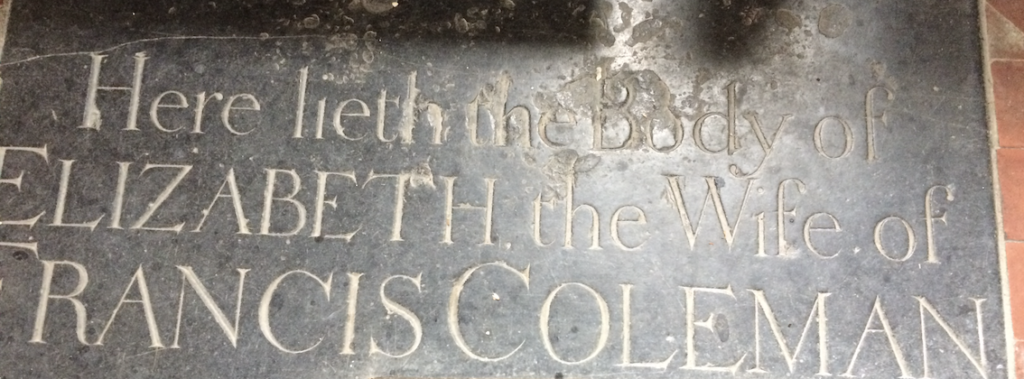
Part of the memorial tablet to the memory of Elizabeth the wife of Francis Coleman
in the floor at the entrance to St James’s Church, Great Ellingham
Fysher Colman’s Tenure of Great Ellingham Hall
Following his marriage and his father’s death, the lordships of the Manors of Ellingham Hall and Ellingham Rectory came to Fysher Colman. Of course, Fysher already had the benefit of the profits and rents from the manors as well as from the Ellingham estate.
We will continue the Colman family’s ownership of the ‘Ellingham estate’ in ‘Fysher Colman’s Tenure of Great Ellingham Hall’.
Sources:
Oxford University Alumni 1500-1886. Ancestry.com. Oxford University Alumni, 1500-1886 [database on-line]. Provo, UT, USA: Ancestry.com Operations Inc, 2007.
Original data: Foster, Joseph. Alumni Oxonienses: The Members of the University of Oxford, 1715-1886 and Alumni Oxonienses: The Members of the University of Oxford, 1500-1714. Oxford: Parker and Co., 1888-1892.
London & Surrey England Marriage Bonds & Allegations 1597-1921. 1 June 1720 Frances Colman. Ancestry.com. London and Surrey, England, Marriage Bonds and Allegations, 1597-1921 [database on-line]. Lehi, UT, USA: Ancestry.com Operations, Inc., 2011.
Original data: Marriage Bonds and Allegations. London, England: The London Archives. Images produced by permission of The London Archives (City of London Corporation).
1714 Land sale from Coleman to de Grey. NRO Ref: WLS XL/6, 420X5
1712 Sheppards House & land sale from Coleman to de Grey. NRO Ref: WLS V/14, 407X8
Margaretta Maria Howman. Baptism. Norfolk England Transcripts of England Baptisms, Marriage & Burial Registers. St Peter Mancroft, Norwich. Norfolk Record Office; Norwich, Norfolk, England; Norfolk Church of England Registers; Reference: AT Norwich city parishes 1716-17
Norfolk, England, Transcripts of Church of England Baptism, Marriage and Burial Registers, 1600-1935 [database on-line]. Lehi, UT, USA: Ancestry.com Operations, Inc., 2018.
Original data: Church of England Bishop and Archdeacon Transcripts of Parish Registers. Norfolk Record Office, Norwich, Norfolk, England.
1743 Marriage. Fysher Colman & Margaretta Maria Howman. Caister St Edmund. Norfolk Record Office; Norwich, Norfolk, England; Norfolk Church of England Registers; Reference: AT Caistor St Edmunds Norfolk, England, Transcripts of Church of England Baptism, Marriage and Burial Registers, 1600-1935 [database on-line]. Lehi, UT, USA: Ancestry.com Operations, Inc., 2018. Original data: Church of England Bishop and Archdeacon Transcripts of Parish Registers. Norfolk Record Office, Norwich, Norfolk, England.
1743 Marriage Daniel Negus & Elizabeth Coleman. St Mary in the Marsh. Norfolk Record Office; Norwich, Norfolk, England; Norfolk Church of England Registers; Reference: PD 499/3Ancestry.com. Norfolk, England, Church of England Baptism, Marriages, and Burials, 1535-1812 [database on-line]. Provo, UT, USA: Ancestry.com Operations, Inc., 2016.Original data: Church of England Parish Registers. Norfolk Record Office, Norwich, Norfolk, England.
Great Ellingham Parish Register Norfolk Record Office PD 609. Also available www.familysearch.org
16th July 1743 Ipswich Journal
Great Ellingham Hall Farm Estate formerly of the Barnard Family. Deeds. Norfolk Record Office
Ref: MC 114/1/36, Part 1, 583X2, Part 2, 583X3
7 November 1741 Ipswich Journal. The British Newspaper Archive