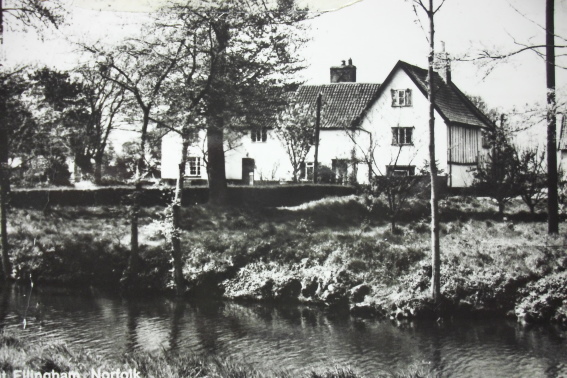
Great Ellingham Hall 1960s
Courtesy Susan Fay
Great Ellingham Hall is a delightful ancient moated manor house which, for centuries, has stood back from Penhill Road in Great Ellingham.
Until c.1825, many of the past owners of the property also held the Lordship of the Manor of Ellingham Hall. One such owner is Anthony Gurney.
Anthony Gurney
The ‘Ellingham estate’ came to Anthony Gurney by his marriage to Margaret Lovell, his first wife. In particular, it appears that Anthony and Margaret acquired the estate following the death of Margaret’s relation, Henry Spelman Esq., of Great Ellingham c.1524. Both Margaret and his second wife, Elizabeth, predeceased Anthony Gurney.
At the time of his death c.1555, Anthony Gurney still owned Great Ellingham Hall and held the lordship of the Manor of Ellingham Hall.
Son & Heir Francis Gurney
Anthony’s heir is his son, Francis, who was born c.1521.
On the 26th August, 1543, Francis Gurney married Helen Holditch. They had six known children, the eldest being Henry, who was born on the 21st January, 1548, at West Barsham, near Fakenham.
Henry Gurney
Henry was the last of the line to be born Roman Catholic. However, he turned to Protestantism following the early death of his father Francis Gurney c.1555.
Henry’s Note-keeping
Henry Gurney made copious notes (many in verse), retained letters, journals and other documents pertaining to his estates, including his estate in Great Ellingham.
References to these documents in a book written by Verily Anderson (a descendant of the Gurney family), have enabled me to piece together some details of the Gurney family’s time in Great Ellingham.
Death of Father
Henry, Francis’s eldest son and heir, was just seven years old when his father died c.1555. His paternal grandfather, Anthony Gurney, had died only a year or so before.
Education
His education (and that of his younger siblings) was funded by a legacy left directly to him by his grandfather. I do not believe that Henry or any of his immediate family, were in Great Ellingham at this time.
It is perhaps more likely that the Gurney family let the manor house at Great Ellingham and the estate houses to tenants. Likely they also installed a steward to deal with the day-to-day business of the Manor of Ellingham Hall.
Grandfather’s Re-Building of Great Ellingham Hall
Before his death, Anthony Gurney had set out re-building Great Ellingham Hall. However it appears that this work was unfinished at the time of his death. Indeed at a later date, his grandson Henry continued with work to the Hall, but on a more modest basis. (The ‘re-building’ of the Hall suggests that there was an earlier manor house on the site).
In the meantime following the death of Anthony Gurney, the Gurney family lived elsewhere but continued to enjoy the rents and profits etc from the Manor of Ellingham Hall. This is in addition to the rents from the letting of any manor house, estate houses, and any other land or property the family owned in the village.
Elizabethan Era
Henry was around the age of 10 when, towards the end of 1558, Queen Elizabeth I acceded to the English throne.
Henry reaches his Majority
He became ‘of age’ (reached 21) in 1569. It is then that Henry takes over the Leet Court at Great Ellingham Hall.
Village Pound
One of the first things he did is to build a new pound (also known as a pinfold) in the village.
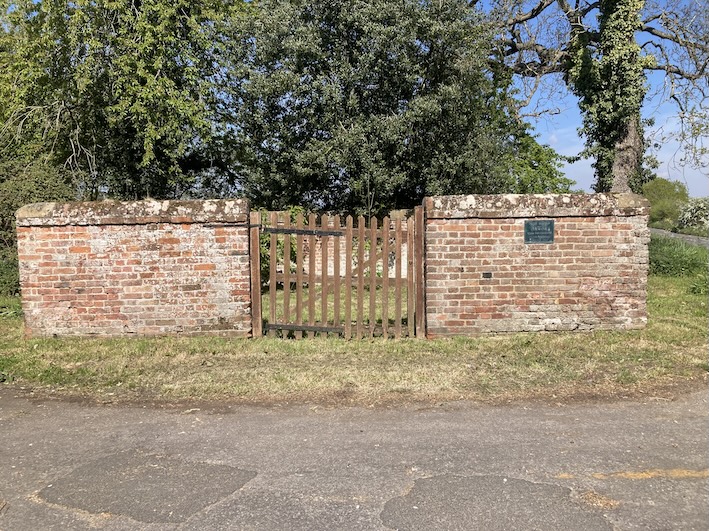
The Cattle Pound at North Elmham, Norfolk built c.1830s.
This is much later than the pound built at Great Ellingham by Henry Gurney in the mid 16th century
Photograph taken May 2026
In those days, the possession of stray animals was a manorial right of some importance. The strays had to be proclaimed in the Church of St James as well as in the nearest two market places (presumably Attleborough and Hingham) and, if not claimed in the next one year and one day, they automatically became Henry’s property!
He also ‘returned’ to his late grandfather’s work in restoring Great Ellingham Hall.
Henry’s Estate
In 1569, Henry’s estate comprise at least the Manor of Ellingham Hall which held land in Great Ellingham, Rockland, Deopham, Morley, Little Ellingham, Hingham and Attleborough; the advowson of part of the church at Attleborough; also 60 acres of meadow and pasture land in Great Ellingham, Deopham, Attleborough, Hingham and Rockland. Also the Manors of West Barsham, North Barsham and East Barsham, Houghton, Sculthorpe as well as the Manors of Gurneys in Hingham, Little Ellingham and Deopham.
Marriage
On the 10th June, 1571, 22 year old Henry Gurney married 23 year old Ellen Blennerhasset.
The work to Great Ellingham Hall had not been completed. Henry’s brother-in-law occupied Henry’s West Barsham house. Further, the remainder of his other houses were let to relatives.
Living with ‘in-laws’
With nowhere else to go, Henry and Ellen began their married life living with Ellen’s family in Norwich. Indeed their first child (a son) was born there. Henry recorded Thomas’s birth at between ‘5 and 6 o’clock in the afternoon’ [of May 10, 1572].
Massive Barn
Meanwhile, work continued at Great Ellingham Hall. Henry began by cutting down timber in the ‘hawe’ or home enclosure “for to build across the moat a massive barn”. He conserved all possible timber for building. Short willow and hazel rods were daubed with mud or clay to form panels between intermediate timbers.
The timber skeleton of the barn was constructed on the ground, and then put in place in a semi-prefabricated state.
This barn was later used as a banqueting hall for many wedding breakfasts. These were usually planned to take place when the barn was empty, having been cleared and ready to take in the new harvest.
New Mill House
Henry surrounded the barn with smaller buildings on the farm side of the moat. He also built a new mill house as well as homes for the shepherds.
The building of a ‘new’ mill house suggests that there was already a mill house. Indeed, records show a mill was purchased for 4 marks in or before 1577. [Typically a mark was worth 13s 4d i.e. 2/3rds of a pound]
This is interesting as I know that by at least by 1685, a windmill stood in the ‘West Field’ in the village. I believe ‘West Field’ to be around the Penhill area – not far from Great Ellingham Hall. However, I have not come across any further reference to a mill owned by the Great Ellingham Hall estate. Further, the reference to the mill in ‘West Field’ is a good 100 years after Henry Gurney built a ‘new mill house’.
Little House
More trees from the ‘hawe’ were used to make a new bridge across the moat. Henry also came across a ‘little house on the other side of the moat’. Apparently this ‘little house’ had been used for guests. It is recorded that Henry’s grandfather’s first cousin, Sir Christopher Heydon and his wife Temperance of Baconsthorpe, had used the ‘little house’. Nevertheless, Henry turned this into a stable.
Hingham Gurneys Estate
Henry brought more mature timbers for the house from his estate at Hingham Gurneys, as well as from his other properties. He also re-arranged some of his late grandfather’s rooms in a more ‘comfortable and less ostentatious manner’.
Move to Great Ellingham Hall
Henry and Elizabeth moved into Great Ellingham Hall around 1574. The couple now had two children. Thomas had been followed by Elizabeth (Bess) in 1573.
A further 11 known children were born to Henry and Elizabeth Gurney between 1574 and 1586, including one set of twin sons. Some of the children may well have been born at Great Ellingham Hall.
Continuance of Changes to the House
Henry continued making changes to the house. He ‘translated the kitchen with its oven into the parlour’ and replaced a window with a bay window. Henry built a new kitchen with a ‘sink house’, modernised the larder, tiled the brew-house, the malting-house as well as a new wash-house.
He also put in a lead pump to serve the wash-house and kitchen. There were two wells serving the property at this time.
Henry put in a staircase in the great entrance hall, which had a ‘huge fireplace and grate’. The staircase comprised of broad treads flanked by stout bannisters. It led to the bed-chambers and then on to the attic rooms.
Outside, Henry pulled down the ‘ancient kiln house or furnis house’ to make a beast house. He also built a cart house, swill house and dove house.
1578 Queen Elizabeth’s Royal Progress
Although Henry’s existence was modest compared to his flamboyant grandfather, Anthony Gurney, by all accounts Henry entertained. Feasts certainly took place at the Hall at the time of Queen Elizabeth I’s ‘Royal Progress‘.
The Queen visited Norfolk in the August of 1578. Banquet menus at the Hall included meat, chickens, pigeons, quails, dotterels, peeweets and gulls as well as oysters. There is also reference to some 420 pounds of butter!
Prudent & Careful
Henry owned over 70 ‘well-known books by distinguished authors’. These were all in his library at Great Ellingham Hall.
It is suggested that he was well-read for the period of time in which he lived. It is also said that Henry was prudent and careful with his money. However, his wife ‘kept the money bags’ and that ‘he was never allowed to spend anything without a cross-word’.
Henry had ‘strong religious feelings’ and ‘a deep interest in his children’. He is also said to suffer from severe hearing loss.
During his lifetime, Henry sold and bought various lands and properties. However, he still owned the Manor of Ellingham Hall and the ‘mansion house’ at the time of his death.
Death of Henry Gurney
Henry Gurney outlived his wife and three of his children. He died at the age of 67 on the 23rd February 1615.
He was born during the reign of Edward VI (son of Henry VIIII). Henry also lived through the ensuing reigns of Lady Jane Grey (the 9-days Queen), Mary Tudor (Mary I), Queen Elizabeth I and James I. Almost certainly Henry will have known of Mary, Queen of Scots, and her claim to the English throne.
Henry Gurney expressed a wish to be buried in St James’s Church, Great Ellingham, in the north aisle next to his wife and daughters. His infant daughter Margaret (Meg) may be buried in the church near to ‘Henry’s favourite brother’ (I believe this to be Thomas). Other members of the Gurney family are also said to be buried in the church.
Henry’s Will
Henry’s eldest son, Thomas, inherited the Great Ellingham and West Barsham estates. He also inherited his father’s silver ewer and basin, gold chain and ‘all his worldly goods’.
Edmund inherited his father’s latin books.
Henry left £200 to each of his daughters, Amy and Abegail. The sum to be paid upon their respective marriages, or paid to each of them two years after his death (if they were still unmarried). Nevertheless in the meantime, they would each receive £20 per annum. Amy was then aged around 40 and Abegail 29.
Most of Henry’s children had already received their ‘portions’ – i.e. their inheritance or, in the case of the daughters, their dowry on marriage.
Henry also left legacies to the poor and to his servants.
As it happens, Henry’s son Thomas died ‘a year and a day’ after his father. Once again a young boy became the heir to this Gurney estate. He is 10 year old Edward (Ned) Gurney.
Sources:
University of Nottingham website https://www.nottingham.ac.uk/manuscriptsandspecialcollections/researchguidance/weightsandmeasures/money.aspx
‘The Record of the House of Gournay. Internet Archive https://archive.org/stream/recordhousegour02gurngoog/recordhousegour02gurngoog_djvu.txt accessed 12 March 2026
https://freepages.rootsweb.com/~kell/genealogy/dad/hooe/mort.pdf
Anderson Verily. 1980. Friends and Relations. Three Centuries of Quaker Families. Hodder & Stoughton. Pages 24, 26, 27, 29-31, 33-4, 37, 39, 44, 47, 62, 69, 75