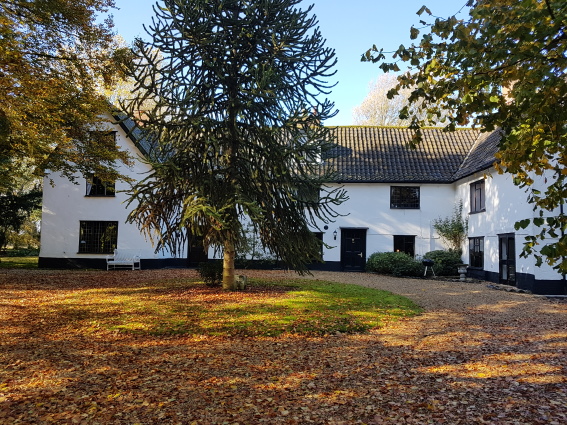
Great Ellingham Hall 2020
Courtesy Tracy Knowles
According to British Listed Buildings, ‘Old Hall Farmhouse’ was built c.1570. It is of a timber framed construction with wattle and daub, and some clay lump infill on a brick plinth.
However from my investigations, there may well have been a house near or on the same site earlier than 1570. Certainly, the Lordship or ‘The Manor of Ellingham Hall’ existed much earlier.
Manorial Land
I am sure that many of us will recall from our school days the historical date of ‘1066’. It was, of course, the year of the Battle of Hastings, when Harold II was defeated by ‘William the Conquerer’.
Following his victory, King William claimed all the land in England. He then sub-divided the land amongst his major barons. These barons received parcels of land in various parts of the country. In effect, King William ensured that no baron owned a large holding of land in one area. Nevertheless, they could chose which part of the country in which to settle (i.e. to have their main seat).
Stewards were installed to administer the day-to-day running of their other estates, although some of these estates may also be sub-infeudated to minor barons or knights.
Peasant labourers (serfs) worked the land and were bound to the lord of the manor. However, a manor usually had one or more ‘free tenants’ (franklins) who held some ‘free’ land. These franklins were not tied to the manor.
Many serfs were allowed to cultivate certain strips of the manor land to feed their own families. Some were also provided with cattle for ploughing. However in return, the serfs were required to carry out work for the lord. The land and cattle were never owned by the serfs. They could be taken back upon a serf’s misdemeanour or death.
Nevertheless over time it became the custom of many manors for the strips or parcels of land to be passed onto the next generation – usually, the eldest son.
Details of these tenancies of the ‘copyhold land’ are recorded in the court rolls (later court books). Court rolls also include details of the ‘leet’ courts (the regulation and administration of local affairs, minor infringements etc).
Manorial Records
Records for the Manor of Ellingham Hall exist from around 1189! [Norfolk Record Office Ref: GB/153/NM/3618].
However to date, I have not made any investigations of these historical records. Nevertheless, I have used other sources to identify some of the early holders (owners) of the lordship of the Manor of Ellingham Hall, and of Great Ellingham Hall itself.
14th & 15th centuries
During the 14th century, the Manor of Ellingham Hall was held by Sir Thomas Mortimer of the Attleborough Mortimer family. However it is unlikely that the present ‘Great Ellingham Hall’ existed at that time.
Sir Thomas and his wife Mary left three daughters and co-heirs. Their third daughter, Margery Mortimer (possibly born c.1377) married Sir John Fitz-Ralph of Great Ellingham in 1403.
Margery’s portion of the ‘Mortimer Estate’ included the Manor of Great Ellingham Hall in Great Ellingham, Scoulton as well as other manors and church preferments. I assume she brought her ‘portion’ (dowry) to her marriage with Sir John Fitz-Ralph. Given that Fitz-Ralph was of Great Ellingham, it seems likely that the couple lived in Great Ellingham. However, I do not know where.
After Fitz-Ralph, the Manor of Great Ellingham Hall eventually came down the line through the families of Conyer and Spelman, and to Ela, the wife of Sir Robert Lovell.
The Manor then passed to their second daughter, Margaret Lovell, who was born c.1500. She married ‘Anthony Gourney of West Barsham, Great Ellingham and Gurney’s Place in St Julian’s Norwich’.
It seems that the spelling of the surname Gourney, Gournay or Gurney did not stabilise to the general use of ‘Gurney’ in documentation until at least the 1700s. However for ease of reference, I will use ‘Gurney’ whether or not this is the spelling found in a particular source.
Anthony Gurney
Anthony Gurney inherited certain estates from his grandfather, William Gurney.
At the time of William Gurney’s death in 1507, Anthony was 18 years old. However he ‘took’ full possession of his estate on reaching 21. Assuming that Anthony was born in 1489, he received his full entitlement in 1510 – just a year after King Henry VIII came to the English throne.
Marriage to Margaret
By his marriage to Margaret Lovell, Anthony Gurney acquired a considerable estate – particularly after the death of Margaret’s relation Henry Spelman Esq., of Great Ellingham c.1524. Henry was an arminger. This is probably when the Manor of Ellingham Hall (along with a manor house) came to Anthony Gurney and his wife.
Marriage to Elizabeth
Following his wife Margaret’s death, Anthony Gurney married Elizabeth Tyrrell. Elizabeth was the widow of Henry Spelman Esq. She brought to the marriage a lifetime use of Bury Hall in Great Ellingham. Accordingly (unless there was any contrary agreement prior to the marriage), Anthony then had the control of Bury Hall.
Ellingham Hall in extreme Dilapidation
When the Manor of Ellingham Hall came to Anthony Gurney, Ellingham Hall and the manor were in an extreme state of dilapidation. Apparently, the Mortimer family (who had held the manor as early as the 14th century), were ‘notoriously neglectful landlords’. It appears that later landlords may have been just as neglectful!
It is said that Anthony Gurney (referred to in later documents written by his grandson, Henry Gurney, as ‘Old Anthony), “found that the house had not been maintained by the space of about 120 years.” It was also overgrown with bushes and trees.
This dates the last ‘maintenance’ of the house back to the early 1400s!
Re-building
This statement certainly suggests that by the 1500s, the Manor of Ellingham Hall had a manor house. Whether the house today (or any part of it) dates back to the 1400s is purely conjecture.
However, there is reference to ‘Old Anthony’ re-building Great Ellingham Hall. Accordingly it is possible that the present house was totally re-built but, perhaps, on the same site as a previous house.
Nevertheless, whilst ‘Old Anthony’ set about the ‘re-building of Great Ellingham Hall’, he and his (2nd) wife Elizabeth lived ‘in relative comfort’ at Bury Hall. By all accounts, ‘Old Anthony’ was somewhat ‘flamboyant’ in his re-building of the manor house.
Work to the House
It is recorded that Anthony discovered that the ‘Great Hall’ was being used as a kitchen and larder. There were hams and herbs hanging from the rafters and cooking carried out on an open fire. Farm beasts had invaded the rest of the house.
Further, cows were splashing through the moat to be milked in the solar. A ‘solar’ is usually the primary living and sleeping quarters for the lord of the manor.
Anthony brought old timber from nearby Scoulton Hall which, it is said, he pulled down. Most of the best timbers were used for spars [beams] for the hall, and he gave (or sold) the remainder to repair the chancel of the church in Hingham. Incidentally by then, Gurney’s Manor at Hingham was the most important of Anthony’s manors.
Deaths of Elizabeth & Anthony Gurney
As it happens, within four years of starting the work, Elizabeth Gurney died. Consequently, Anthony Gurney no longer had the use of Bury Hall. It reverted back to the Mortimer family.
It was not long after the death of Elizabeth that Anthony Gurney died on the 13th January c.1555. He is buried at Great Ellingham church.
Anthony Gurney was survived by his son, Francis Gurney born c.1521, and two younger daughters. It is Francis who inherits his father’s estate, including the ‘Great Ellingham estate’.
Sources
‘The Record of the House of Gournay. Internet Archive https://archive.org/stream/recordhousegour02gurngoog/recordhousegour02gurngoog_djvu.txt accessed 12 March 2026
https://freepages.rootsweb.com/~kell/genealogy/dad/hooe/mort.pdf
Mortimer History Society https://mortimerhistorysociety.org.uk/wp-content/uploads/Mortimers/Genealogies/OUTLINE-LINEAGE-7.11.pdf
McLaughlin Eve. 1996. Manorial Records. Parchment (Oxford) Ltd. Pages 1-6.
Anderson Verily. 1980. Friends and Relations. Three Centuries of Quaker Families. Hodder & Stoughton. Pages 24, 26, 27, 29-31, 33-4, 37, 39, 44, 47, 62, 69, 75.