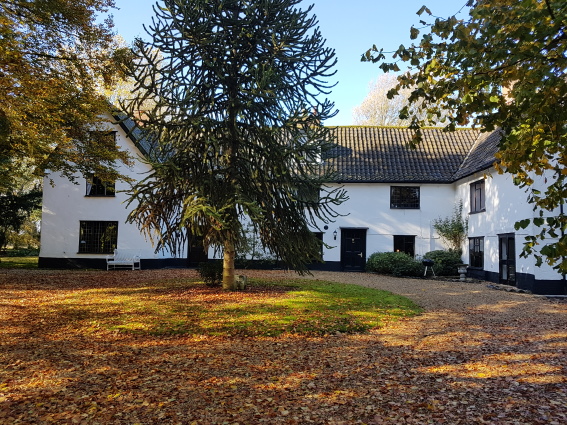
Great Ellingham Hall 2020
Courtesy Tracy Knowles
Great Ellingham Hall is a delightful centuries old moated manor house in the heart of Great Ellingham. This Grade II listed building is tucked away in its own grounds off Penhill Road.
Other articles on this website cover the earlier history of the house and the Manor of Ellingham Hall. They cover the tenure of the families of Gurney, Davy and Potts, as well as the beginning of the Coleman family’s ownership.
It was not until around 1825, that the lordship of the Manor of Ellingham Hall was separated from the ownership of the Hall.
Here, we take the Colman family’s ownership forward from the death of Francis Coleman in 1743.
Francis Coleman
Francis Coleman was born c.1670. He had at least two marriages. At the age of 42 (and before his marriage to Elizabeth Fisher), Francis purchased the ‘Ellingham estate’.
The estate comprised Great Ellingham Hall, the lordship of the Manor of Ellingham Hall (and later also the Manor of Ellingham Rectory), several houses and land in Great Ellingham, Little Ellingham, Rockland St Peter, Rockland All Saints, Attleborough, Deopham, Hardingham and Morley.
Francis’s second wife, Elizabeth Coleman (nèe Fisher), died in her 62nd year on the 7th September, 1742.
Ellingham Estate
In the July of 1743, Francis Coleman ‘settled‘ the Ellingham estate on his only son and heir, Fysher Colman upon his marriage to Margaretta Maria Howman.
Fysher Colman marries
The couple consequently married in the parish church of Caister St Edmund on 6th July, 1743.
The marriage was reported in the Ipswich Journal on Saturday 16th July 1743.
“Last Tuesday Fisher Colman Esq., of Great Ellingham in Norfolk, was married at Castor [sic] Church, by the Rev. Mr Manlove, to Miss Howman, of the City of Norwich, an agreeable young Lady, with a large Fortune”
Prior to Fysher’s marriage, Great Ellingham Hall is occupied by Layer Vynne. I do not know whether the Fysher and Margaretta Colman came to live at the Hall at any time during their marriage.
Death of Francis Coleman
Francis Coleman died on the 1st September 1743, just over a week or so before the marriage of his daughter Elizabeth Coleman to attorney-at-law Daniel Negus. He was 73.
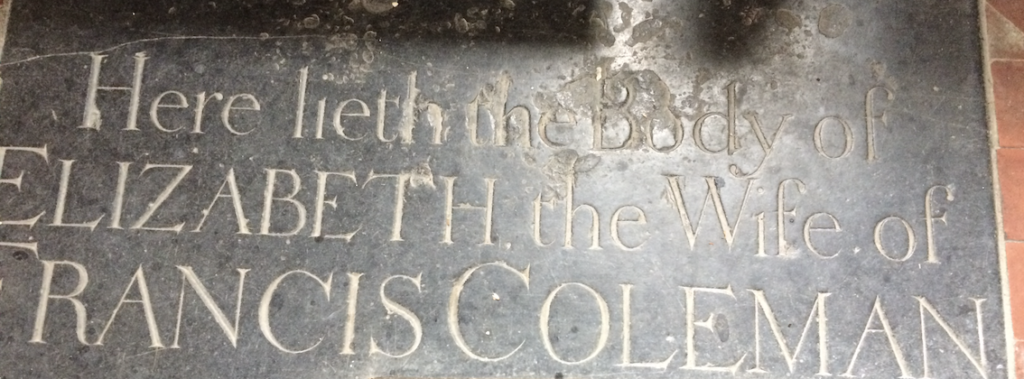
Part of the memorial tablet to the memory of Elizabeth the wife of Francis Coleman in the floor
at the entrance to St James’s Church, Great Ellingham
Francis and his wife Elizabeth nèe Fisher are buried in St James’s Church.
The inscription on the memorial tablet set in the floor at the entrance to St James’s Church refers to Francis and Elizabeth as Coleman. However, memorials to their son Fysher in the same church use the spelling Colman.
I have found that the spelling of ‘Fysher’ and ‘Fisher’ and ‘Coleman and Colman’ are interchangeable. However, it seems that the surname ‘Colman’ is more often found in references to Fysher Colman. I will use the spellings of ‘Fysher’ and ‘Colman’ whether or not this is the spelling found in the particular source.
Lord of the Manors
Following his marriage and his father’s death, the lordships of the Manors of Ellingham Hall and Ellingham Rectory came to Fysher Colman. Of course, Fysher already had the benefit of the profits and rents from the manors as well as the Ellingham estate.
Daughter
Fysher and Margaretta Colman’s only known child, their daughter Elizabeth Fysher Colman, was born in January, 1745. She was baptised at the parish church of St Peter Mancroft, Norwich on the 5th February. I assume that Fysher and Margaretta lived in Norwich, and they continued to let Great Ellingham Hall.
Sadly, Elizabeth died at the age of 3 years 11 months and 13 days on the 14th January, 1749. She was buried at Great Ellingham on the 16th January.
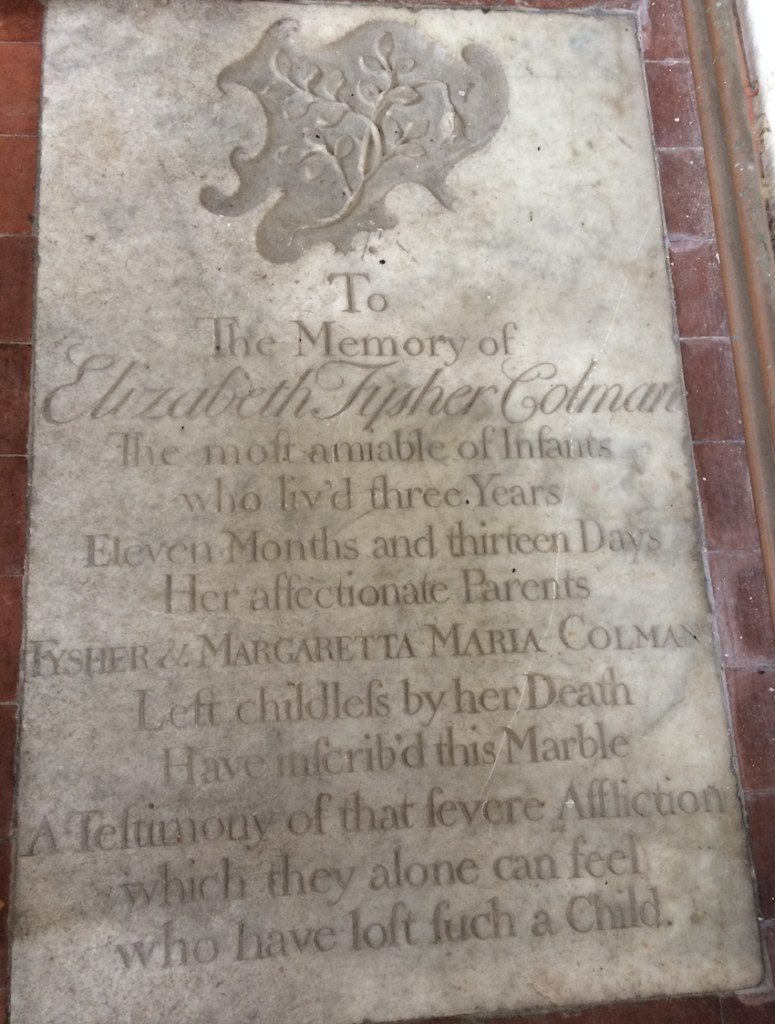
Memorial to the memory of Elizabeth Fysher Colman the daughter of Fysher & Margaretta Maria Colman
in the floor of St James’s Church, Great Ellingham
The memorial tablet in the floor of St James’s Church describes Elizabeth as “the most amiable of infants”.
Attorney John Barnard
Whilst Fysher and Margaretta were living at the Cathedral Precincts in Norwich , Fysher Colman appointed John Barnard of Great Ellingham as his attorney. This is evidenced by a letter of attorney dated 1750 (NRO ref: MC 2213/54).
I have not seen the letter but assume that Barnard was Colman’s steward at the Ellingham estate. He would have overseen the administration for the Manors of Ellingham Hall and Ellingham Rectory, held the manor courts and generally dealt with the Ellingham estate on behalf of Fysher Colman.
Fysher Colman makes his Will
Some four years after his daughter’s death, Fysher Colman signs his last will and testament on the 18th September, 1753. He and his wife are still living at the Precinct of the Cathedral Church in Norwich.
We can but wonder whether Fysher was already living with an illness at this time.
Death of Fysher Colman
Fysher Colman died at the age of 37 on the 27th July, 1758. He is also buried at the church in Great Ellingham. However, his burial entry for the 8th August, 1758, mentions that Fysher Colman came ‘from Bath’.
I do not know whether Fysher died in Bath, or visiting his Great Ellingham estate when he died.
In any event, it is no surprise that Fysher is buried in the same church as his young daughter.
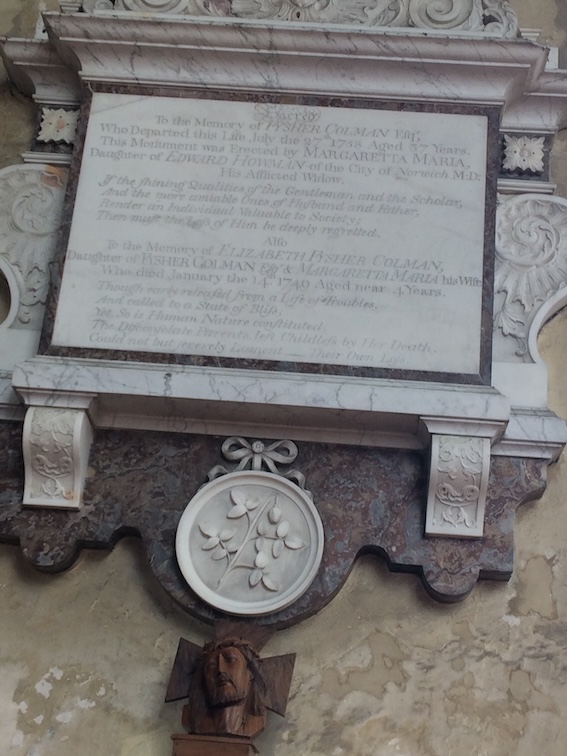
Marble wall memorial to Fysher Colman and his daughter Elizabeth Fysher Colman erected by Fysher’s wife, Margaretta Maria Colman
in St James’s Church, Great Ellingham
Fysher Colman’s Will
Fysher appointed his wife Margaretta Maria as his sole executrix. Margaretta was then in her early forties. Fysher left no surviving children.
Ellingham, Ashwellthorpe, St Peter Mancroft
At the time of his death, and in addition to the ‘Ellingham Estate’ (which included Great Ellingham Hall), Fysher Colman owned houses and land in the parish of St Augustines in Norwich, houses and lands in St Peter Mancroft, Norwich, and property and lands in Ashwellthorpe. His will includes lifetime interests in his properties, apart from the property in St Augustine, which he directs to be sold.
St Augustine
The money raised from the sale of the St Augustine’s properties is to be used to discharge his debts, pay legacies and his funeral charges. Any surplus money is to be paid to his wife.
Ellingham & Ashwellthorpe
Margaretta Maria had a life interest in the Ellingham Estate as well as Fysher’s properties and land in Ashwellthorpe.
Her life interests are subject to an annual sum of £12 payable to spinster Mary Edgar of (Great) Ellingham. The Ashwellthorpe properties were also subject to an annual sum of £5 to widow Elizabeth Ashby of Norwich. These annuities were limited to the respective lifetimes of Mary Edgar and Elizabeth Ashby.
After the death of his wife, Fysher left his estates in (Great) Ellingham and Ashwellthorpe in trust for the lifetime benefit of his sister Elizabeth (wife of Daniel Negus). This lifetime interest is also subject to the annuities in favour of Mary Edgar and Elizabeth Ashby, as well as an annuity of £10 payable to Hannah Moss – referred to in the will as ‘my servant.
St Peter Mancroft
Fysher also left his properties in Saint Peter Mancroft in trust for the benefit of his sister, Elizabeth Negus, again limited to her lifetime. This is subject to her keeping the same in good repair.
Following the deaths of both his wife and his sister, these properties would pass to any children (both male or female) of Elizabeth Negus on them reaching the age of 21, or on marriage, whichever happens the sooner.
Margaretta’s Separate Estate
However, the Ashwellthorpe properties (which are then in the occupation of James Elmer) are charged with the sum of £800. Fysher consents to his wife leaving this sum by way of her last will as she wishes.
We are in a time when under common law, a husband and wife were one person, and a woman had no independent legal identity. A husband had to expressly agree to his wife making a will.
Nevertheless, this £800 does not become payable until two years after the death of Margaretta.
Default Clause
Should his sister Elizabeth Negus not leave any surviving children, then all her interests in the various properties revert to his wife (if still living) and Jane Fysher, the second daughter of Francis Fysher Esq. of Grange, near Grantham and widow Susanna Dunbar of Aldermanbury, London and Mary Edgar. Again, this is subject to the £800 which Margaretta can leave by her will, and the modest annuities mentioned in the will.
Further Legacies
Fysher left Robert Bedingfield (one of his trustees) the sum of £50, to be paid from the proceeds of the sale of his St Augustine’s properties.
He gave his Jacinth ring (reddish-orange gem) to Mrs Priscilla Digby.
‘Mrs Negus’ the wife of Henry Negus received Fysher’s watch and twenty guineas “in memory of our friendship”.
He left ten guineas to the Poor of Ellingham.
In two later codicils, Fysher left gifts of five guineas each to Mrs Edgar and Mrs Harcourt, and twenty guineas each to “my friends Steele and Littleton as a token of my gratitude”.
All of his real or personal estate is devised to his wife.
Lady of the Manor
Following Fysher Colman’s death in 1758, his widow Margaretta Maria became the ‘Lady’ of the Manors of Ellingham Hall and Ellingham Rectory.
I do not believe that following Fysher’s death Margaretta Colman ever lived at Great Ellingham Hall. Indeed (and as mentioned earlier), I am unclear as to whether Fysher and Margaretta lived at The Hall at any time during their marriage.
However, given that their daughter Elizabeth was baptised and buried at St James, it is possible that the couple lived there during the early part of the marriage. They may have spent part of the time in Norwich and the other in Great Ellingham.
Alternatively, the house and farm may well have continued to be let.
Francis Colman Negus & Daniel Negus the Younger
On the 15th May 1766, the late Fysher Colman’s sister, Elizabeth Negus, assigns her interest in the Ellingham and Ashwellthorpe estates to her eldest son, Francis Colman Negus.
A day or so later, Elizabeth Negus and her sons, Francis Colman Negus and Daniel Negus convey the late Fysher Colman’s estate in St Peter Mancroft, Norwich, to trustees, John Sayer of Eye and Philip Meadows of Diss.
At this time, Francis Colman Negus is living at Clare Hall Cambridge. His brother, and I believe his mother, are living in Eye, Suffolk.
House for the Poor of the Village
On the 2nd August, 1769, widow Margaretta Maria Colman, then living in Hurst in Berkshire, signed an agreement for a Town House (a house for the poor of the village), to be built on land owned by the Manor of Ellingham Hall.
Margaretta Maria Colman signs her Will
On the 4th March, 1774, Margaretta puts her affairs in order and signs her will.
Her will refers to her interest in an estate in Ashwellthorpe, as well as the £800 which her late husband, Fysher, settled on her by his will. The Ellingham Estate is not mentioned as Margaretta only has a life interest in the estate.
The trusts for the Ellingham Estate and other lands once owned by Fysher Colman, continue to be held and managed by the trustees of Fysher Colman’s will.
Daniel Negus is buried in Great Ellingham
The late Fysher Colman’s brother in law, Daniel Negus, died in October 1775. Although of Eye in Suffolk, his widow, Elizabeth (the daughter of Francis Coleman), arranged his burial at Great Ellingham church for the 23rd October.
We can but wonder whether Margaretta Maria Colman made the journey from her home in Berkshire to attend the burial service at St James’s Church.
Death of Margaretta Maria Colman
A widow for some 22 years, Norwich born Margaretta Maria Colman nèe Howman died in Windsor, Berkshire on the 19th September, 1780. She was 63 years old.
In her will, she mentioned her desire to be ‘decently interred’ in the Parish Church at Great Ellingham as near to the bodies of her late husband, Fysher Colman, and her late daughter, Elizabeth Fysher Colman.
Her burial took place on the 3rd October, 1780.
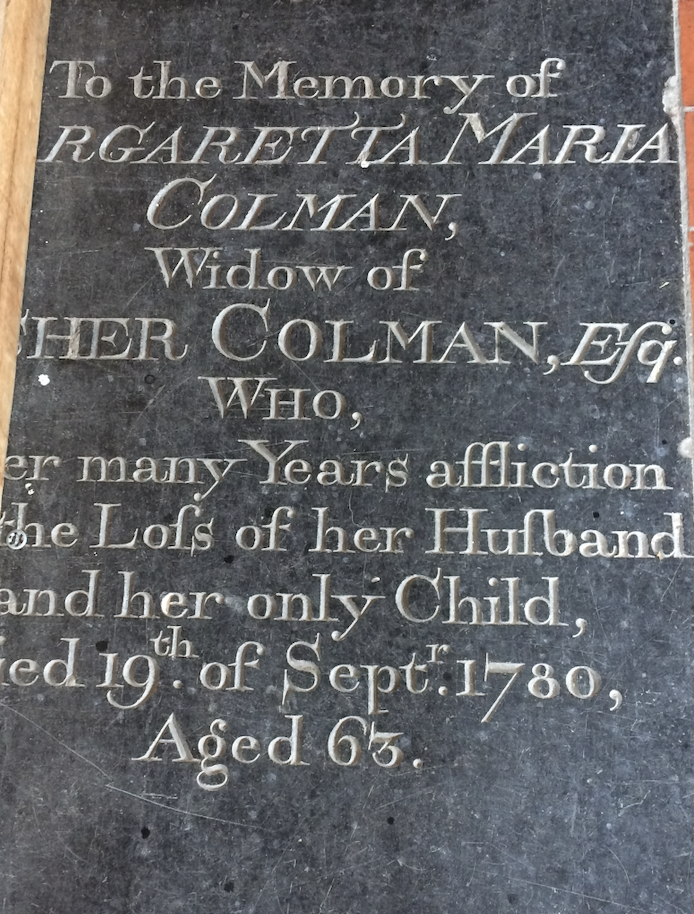
Memorial tablet to Margaretta Maria Colman in the floor of St James’s Church, Great Ellingham
[Part of the tablet is obscured by church furniture]
Margaretta Colman left various generous legacies in her will, including a small legacy to the Poor of Great Ellingham.
However, as she only had a life interest in the Ellingham estate (including Great Ellingham Hall), it is not hers to leave to any beneficiary.
The Ellingham Estate from 1780
Following the deaths of both Fysher and his wife Margaretta, the late Fysher Colman’s Ellingham Estate with the Manors of Ellingham Hall and Ellingham Rectory, and the Ashwellthorpe estate continue to be legally owned and managed by the Trustees appointed by the Colman and Negus families.
Sources:
Baptism 1745 St Peter Mancroft. Elizabeth Fisher Colman. Norfolk Record Office; Norwich, Norfolk, England; Norfolk Church of England Registers; Reference: PD 26/27. Ancestry.com. Norfolk, England, Church of England Baptism, Marriages, and Burials, 1535-1812 [database on-line]. Provo, UT, USA: Ancestry.com Operations, Inc., 2016. Original data: Church of England Parish Registers. Norfolk Record Office, Norwich, Norfolk, England.
Great Ellingham Parish Registers Norfolk Record Office PD 609. Also available www.familysearch.org
16th July 1743 Ipswich Journal
Great Ellingham Hall Farm Estate formerly of the Barnard Family. Deeds. Norfolk Record Office
Ref: MC 114/1/36, Part 1, 583X2, Part 2, 583X3
Fysher Colman. England & Wales Prerogative Court of Canterbury Wills 1384-1858. Probate 11 Aug 1758. The National Archives; Kew, Surrey, England; Records of the Prerogative Court of Canterbury, Series PROB 11; Class: PROB 11; Piece: 839 Ancestry.com. England & Wales, Prerogative Court of Canterbury Wills, 1384-1858 [database on-line]. Provo, UT, USA: Ancestry.com Operations, Inc., 2013.
Margaretta Maria Colman. England & Wales Prerogative Court of Canterbury Wills 1384-1858. Probate 7 Nov 1780. The National Archives; Kew, Surrey, England; Records of the Prerogative Court of Canterbury, Series PROB 11; Class: PROB 11; Piece: 1070 Ancestry.com. England & Wales, Prerogative Court of Canterbury Wills, 1384-1858 [database on-line]. Provo, UT, USA: Ancestry.com Operations, Inc., 2013.