The recording of everyday histories is of vital importance. Written accounts often focus on prominent figures and major events. Documenting daily life preserves the lived experiences of ordinary people.
Great Ellingham is particularly indebted to two Great Ellingham inhabitants who recorded some of the history and life in the village: William Robert Lebbell (1884-1965) and Harry Rix Jnr (1921-2001). Both men also served the village as Parish Clerks.
With his granddaughter, William Lebbell produced an informative booklet about the history of the village.
In 2001 (and at the age of 80), Harry Rix sat down and recorded his boyhood memories of the village. What follows are extracts from Harry’s memoirs, collated by his daughter. But first, let me introduce Harry Rix.
Harry Rix Jnr
Henry Robert Rix was born in a cottage in Long Street on the 1st December, 1920 to Henry Charles Rix (Harry Snr) and Hester.
By 1923, the family moved to a cottage in The Street (now Church Street) opposite Mill Farm. However before 1928, the family relocated to a prefabricated bungalow along the Attleborough Road.
In later years, Harry Jnr and his wife lived in Penhill Road. The Rix family were a well-known village family.
Southern side of Attleborough Road
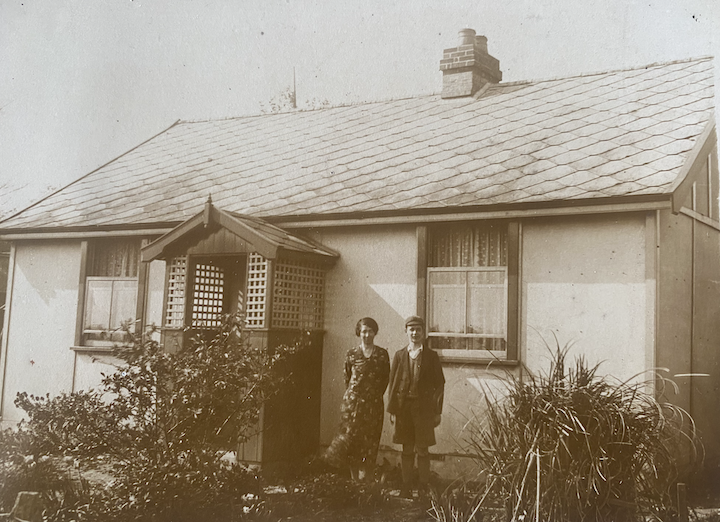
Hester Rix with son Harry Jnr.
Courtesy Elizabeth Neil
Before the age of 7, young Harry moved with his parents to a bungalow along the Attleborough Road. It follows that Harry begins his ‘tour’ of the village in Attleborough Road.
Baptist Cottage & Cemetery
On the southern side of the village towards Attleborough at about 300 yds from the main public highway a small cottage existed standing in its own enclosure.
Part of the enclosure was a cemetery and was known as the Baptist Burial Ground, catering mainly for deceased Baptist adherents including members of the Colman family who had their own burial vault.
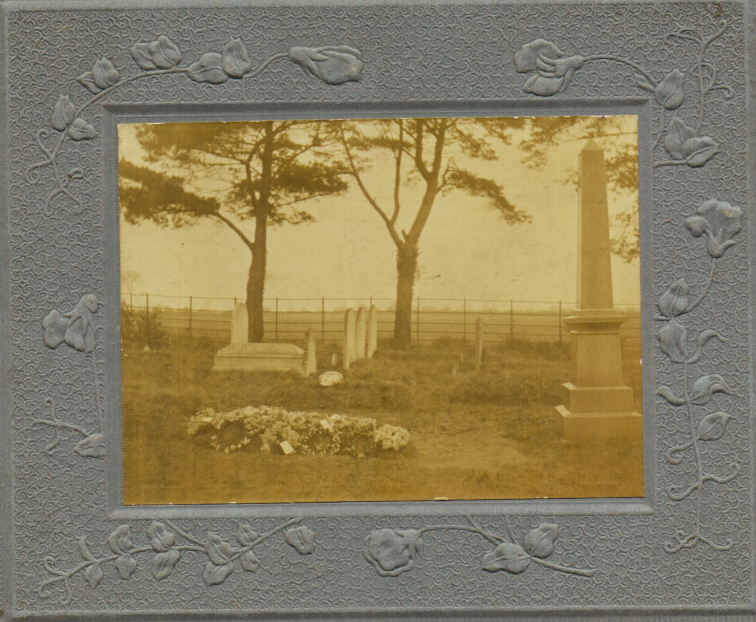
Photograph of the Baptist Burying Ground
Courtesy of Joan Barnard
The Colman family farmed in this parish and in the neighbouring village of Rocklands, from which parish some of the deceased Colman bodies were disinterred and taken to Norwich for re-burial, a process at which a later incumbent remarked “They left Rocklands as Anglicans and arrived at Norwich as Non-Conformists.”
John & Betsy Lincoln
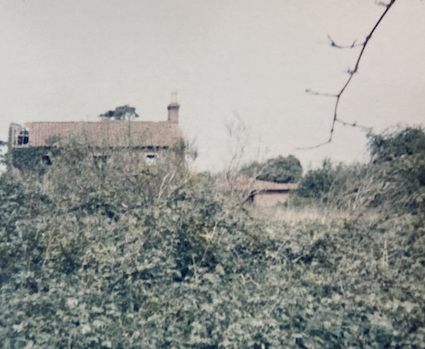
Burial Ground Cottages in some state of dilapidation. c.1970s
Courtesy Robert Daniels
Getting back to cemetery cottage, this was occupied by John Lincoln and his wife Betsy. John did agricultural labouring work and any similar work which came along including grave digging.
His method of determining the dimensions needed for the grave was by a length of string for the length of the excavation with a knot part way along the string for the width of the excavation at its widest part. It is said that John was economical in his digging work, to the extent that if the coffin being interred rubbed against the sides of the grave whilst being lowered into place, John would have to be restrained from jumping on the coffin to force it down into place.
Betsy Lincoln would be seen most days of the week wearing her patchwork blue and red garments, accompanied by a woolen shawl as she made her way along the main Attleborough to Ellingham road and along the footpath which leads from the main road towards the Crown Public House on her way to Mill Farm which was farmed by Mr. Obadiah Wigby.
Mr. Wigby kept a small number of cows, which enabled him to sell milk to the customers, such as Mrs. Lincoln, who collected at the farm in their own vessels which they referred to as boilers (bilers). These were constructed from sheet metal in a circular vessel about 4" in diameter, 7" in length with a truncated conical upper section about 2" in height with a hinged lid and carrying handle. When she had received some milk Mrs. Lincoln returned along the footpath from the Crown Public House to the Attleborough highway. My family lived in a bungalow located at the side of the footpath. On reaching that point Mrs. Lincoln would call out to my mother “Hi Mar (mother) bring out your biler and have some of this milk”, after giving away some milk and some conversation Betsy set off back to her home.
Queens Head Public House
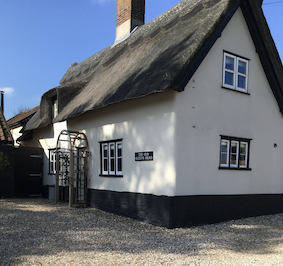
The former Beer House and Queen’s Head Public House
Photograph taken 2019
At the end of the access to the Attleborough road stands what was called the Queens Head Public House – this was a beer house i.e. it was not licensed to sell spirits or wine. The access was tracks left by wheel tyres leading to the Baptist Cemetery although wheeled traffic was infrequent, most times the foot was the main way of getting to and fro.
Wayside
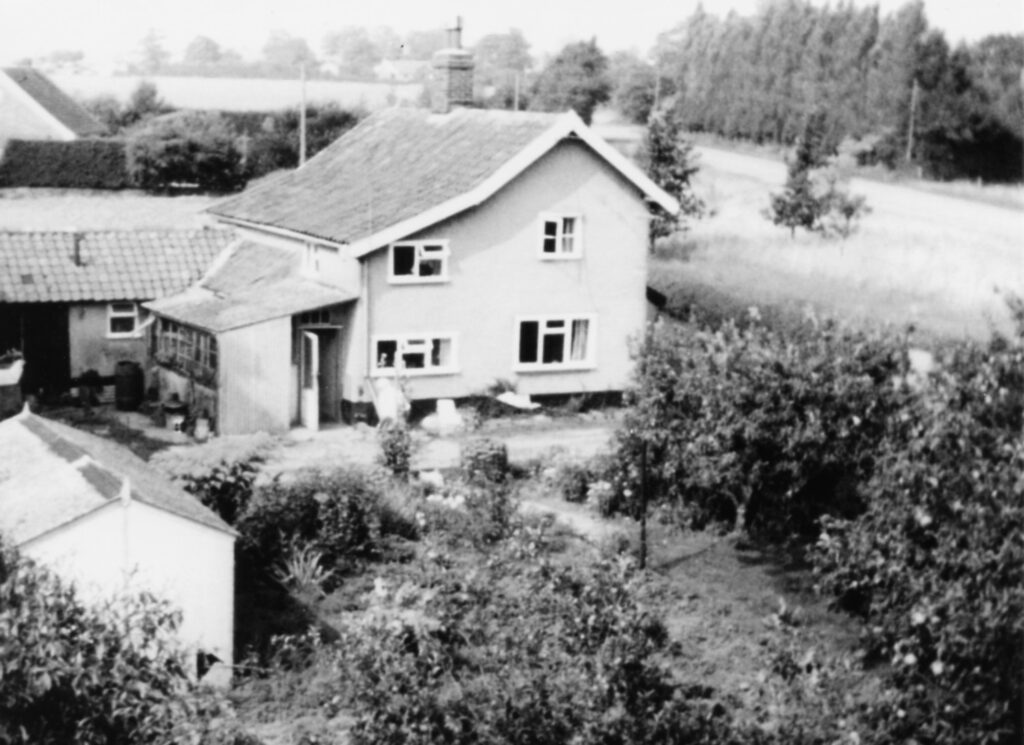
Wayside, Attleborough Road. 1970
Courtesy Jane Brand
Going northwards from the ‘Queens Head’ along the Attleborough Road the next cottage was named ‘Wayside’ and was the home of Mr. & Mrs. William Kettle (or Kittle). The homestead also included a small parcel of land which Mr. Kettle farmed, although his main work was as a N.C.C. roadman (lengthman). He had a small amount of tools such as a shovel, broom, sweeping broom, rammer, tar pot, line and handcart.
These items were stored at nights and weekends in a lean to shed which was located at the end of the wheelwrights workshop (now known as Glenfield). From this little depot Mr. Kettle would go forth on a Saturday morning to check and ensure that the roads in the village were in satisfactory order for Sunday. Mrs. Kettle had the misfortune to have a clubfoot and because of this was not able to venture far unaided.
Rix’s Bungalow
Going further northwards along the Attleborough Road one passed a small bungalow, which was on the north side of the footpath leading to the Crown, which was occupied by Mr. & Mrs. Rix. Mr. Rix was the village carpenter, Mrs. Rix was involved in village activities such as collecting for hospital funds. This meant getting on her bicycle and going to remote parts of the village to collect a few pence from residents, often to be told “We can’t give you money this week, will you call again next week?”.
Bury Hall Cottages
Going further northwards along the Attleborough Road, the next building one came to was a pair of cottages known as Bury Hall Farm Cottages. These stood at the east end of the churchyard and were occupied by Mr. & Mrs. Lambert and family and Mr. Edwards with his daughter and family.
The cottages were built from fletton brick and terracotta tiles probably at about the end of the *1880s as indicated by the use of fletton bricks which were made about then and would have been transported by rail to Attleborough station. It is likely that as the cottages were part of the Bury Hall property, the bricks used for their construction were carted from Attleborough by farm staff by farm staff using carts and wagons.
*From my investigations, I believe the pair of cottages were built earlier than 1880s.
At the northern end of the cottage gardens the churchyard wall adjoins and here an access doorway is located for the use of clerics and members of church congregation.
Wheelwright’s House & Workshop
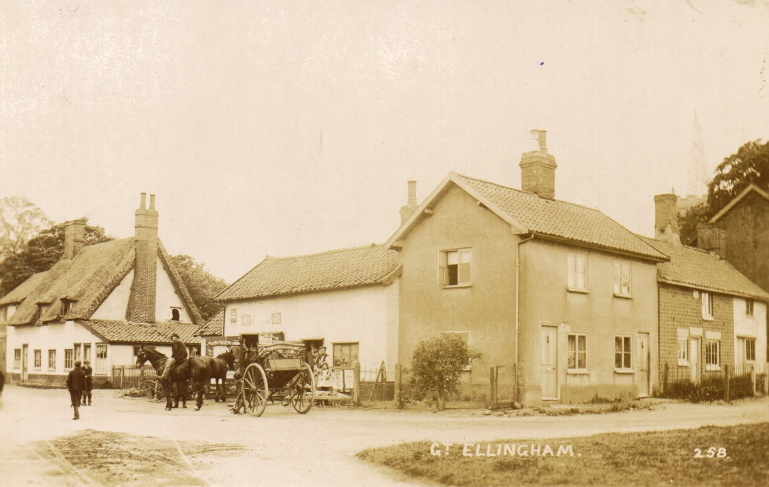
Before 1939. Left Wheelwright and Carpenters Shop of William Kybird
Centre King’s Blacksmith’s Workshop and adjoining house
Postcard Joan Barnard
Going a bit further northwards along the Attleborough Road we come to the wheelwrights. This is a white colour washed walled building with pantile roof in part and partly roofed with thatch.
The wheelwright was Mr William Kybird who was crippled as a result of an accident when he had the misfortune to sever a leg tendon with an adge.
The south side of the thatched roof of the house has a pantiled roof lean to which Mr. Kybird constructed for use as a room to enable a farm wagon to be housed in a dry area for painting in the usual agricultural livery.
The main pantiled part of the wheelwright’s workshop was a two storey building with workshop on the ground floor and storage for timber etc. on the first floor.
Running alongside the boundary wall next to the churchyard was a saw pit which would mean deliveries of timber in the form of tree butts to the wheelwrights yard to be converted to timber. In addition to his week day job, Mr. Kybird was also involved in work in the parish church where he would be seen at worship on Sundays and festivals. In this he would be assisted by Mrs. Kybird, one action which stays in one’s memory is of Mrs. Kybird’s regular opening of the church vestry door as the priest was recessing at the finish of a service in church.
Mrs. Kybird’s sister, Miss Butler lived next door to Mr. & Mrs. Kybird.
Blacksmith’s House & Forge
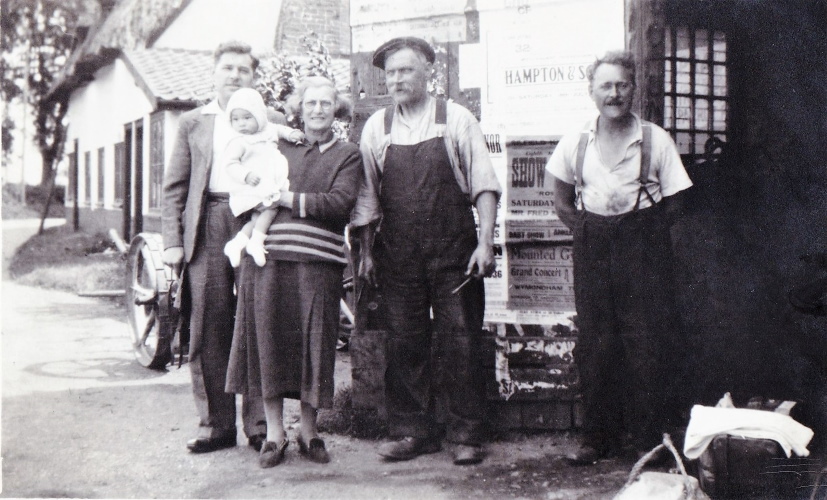
Blacksmith Andrew King in the centre with his wife, Mary Naomi King holding a grandson.
Two sons of the couple also in the photograph which was taken outside his Smithy in Great Ellingham.
Photograph courtesy of Patricia Whiteaker
Moving a bit further along the Attleborough Road there was a blacksmiths shop which was owned and worked by Mr Andrew King who was a blacksmith and farrier. Mr King’s dwelling still exists but the forge, and the blacksmiths equipment, including machines for forming steel rims for cart wheels and rim shoeing platform together horse stalls, did not survive the 20th century. Mr. Kings and his wife Naomi and family lived at the blacksmith’s house.
The blacksmith’s house is located close to the crossroads at which junctions are formed with the Attleborough Road, the ‘through’ road to Rocklands, and branch roads leading to Hargham and Deopham.
Northern side of Attleborough Road
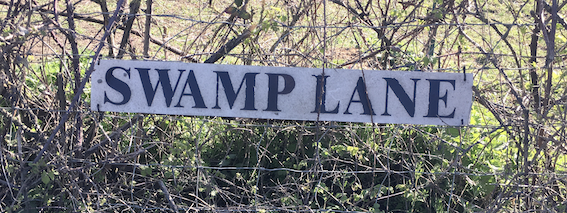
Firstly at about the opposite side of the road from the Queens Head lies Swamp Lane, which is a cul-de-sac. The largely unmade lane eventually leads onto Bulls Meadow and to the Deopham Road.
Bulls Meadow
I feel that Bulls Meadow is worthy of some comment. They were rough grazing almost ‘wet land’ in the winter months, and formed a habitat for numerous snipe and more common wild birds such as blackbirds, thrush, lapwing and smaller birds. To deal with the surface water several ditches criss-crossed the area and thorn bushes grew up at random from seeds dropped by birds.
A small stream traversed the area, which was actually one of the headwaters of the river system. This merited a few timber bridges and brick built culverts to give access to various parts. Water cress grew in some sections. Grazing cattle had trodden a part of the stream banks down in one area. This caused small pools to form which, in the spring and summer, became warm. They were favourite places for frogs to spawn which subsequently gave rise to numerous tadpoles.
In one part of the meadow a ditch widened to about 10ft and had a sandy bottom. Here small upheavals of sand could be seen from springs of water rising from the sandy floor. I was told by an older person that in 1921 the district was affected by a prolonged and severe drought. Bulls Meadow was one of the few local spots where there was a safe drinking water source. Days now gone by!
Stubbings
Starting again at the end of Swamp Lane next to the Attleborough Road. On the right hand side of the lane, there was a dwelling occupied by a husband, wife and family, where you might hear a female voice speaking with a north country accent. That would be Mrs. Stubbings who came from Carlisle. Before marrying Mr. Stubbings she had a marriage where her surname was Collins. Therefore, some of the children were named Collins and some Stubbings. Mr. Stubbings was of more local extraction and operated a knackers business, with several sheds and places of accommodation.
Laws, Wilkins & Long
Going to the next property along Swamp Lane was a house where Mr. & Mrs. Laws and their daughter reside. Adjoining the Laws’ property was a collection of dwellings occupied by the Wilkins family. Here it should be noted that the Wilkins family is one which has the longest residence in Great Ellingham.
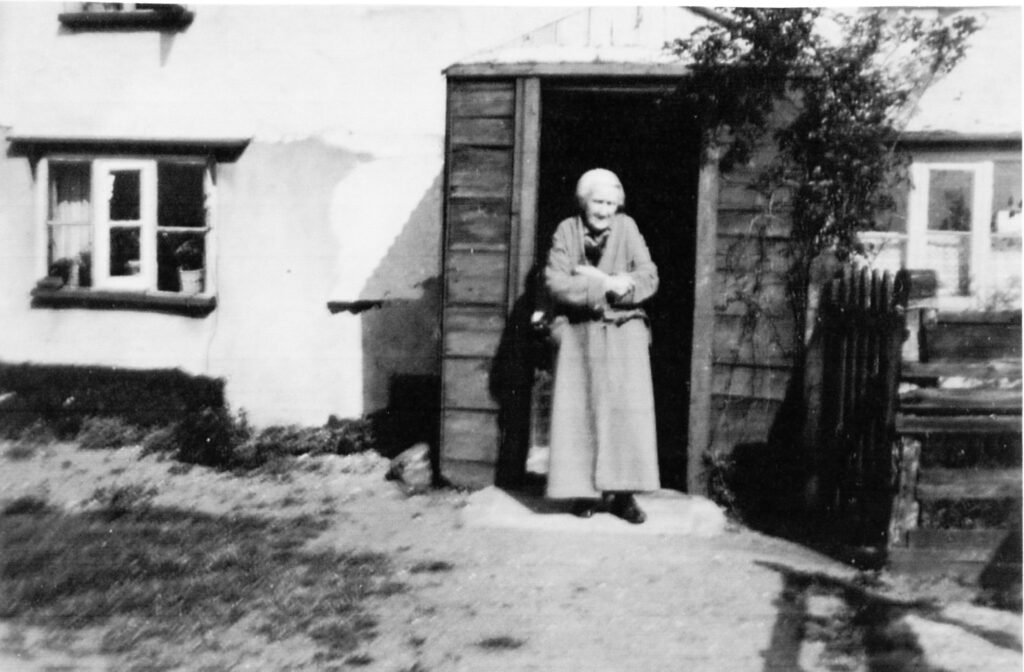
Jane Wilkins nèe Rivett (1867-1950) outside her Swamp Lane home
Courtesy Shirley Caston
Next to the Wilkins family were Mr. & Mrs. Long and their son.
Morter & Burton
Crossing the lane one reaches a dwelling which was occupied by the Morter family.
Moving along to the end of the lane, a holding of house and buildings with some land, was occupied by Mr. Burton & family.
Thatched Barn
Retracing our footsteps along Swamp Lane to the Attleborough Road and going northwards on the offside of the road, we pass a pair of cattle lodges set at right angles to the side of a straw thatched barn (typical Norfolk yard arrangement). The barn would be used to house straw and animal fodder. At times, it would provide a warm night's shelter for a vagrant on his way to Gressenhall, to another poor law workhouse. He would not have to give a day's labour if he used the barn, whereas he might not get off so lightly if he used a workhouse to provide for his needs.
Wigby’s Retirement Bungalow under Construction
Continuing along the offside of the Attleborough Road northwards, a dwelling was being constructed. Most of the foundation trenches had been excavated. It was evening when I saw what had been done earlier in the day and whoever had been carrying out the work was an avid smoker, as the bottoms of the foundation trenches were well littered with Woodbine cigarette packets (5 cigarette size).
Continuing along the offside of the Attleborough Road northwards. At a point about opposite to the Bury Hall farm cottages, and in the roadside hedge-line, a drinking water well was located.
Well
The well consisted of a red brick lined shaft. It was about 3ft 6in in diameter and about 18ft in depth below ground level with the brickwork made into a square formation on which a timber framework and chain and windlass for raising buckets full of water from the depth of the well was located.

Occasionally the bucket would detach itself from the equipment at the end of the chain and fall to the bottom of the well.  To retrieve the lost item a length of line and a set of creepers was needed.  Creepers consisted of 3 metal hooks. Each hook being placed at 135 degrees to each other. When lowered into the clear water with some degree of skill and luck, it was possible to attach the creepers to the missing bucket, which could then be lifted up and out of the well.
This well provided a supply of drinking water for Bury Hall cottages, H Rix bungalow and by underground pipe to a pump located in the bungalow which was under construction.
Most dwellings in the village has some method of collecting rainwater from roofs (by rainwater butts or metal tanks for washing purposes. This water was ‘soft’ and preferred by many for washing purposes.
The bungalow mentioned above was for occupation by Mr. & Mrs. Wigby on their retirement from Mill Farm.
Later on, and after the death of his wife, Mr. Wigby had a small bungalow built on an adjoining plot.
On the North side of the bungalow mentioned above there was a public footpath which crossed various fields to a property known as Tanyard Farm.
Parsonage House & Parish Room
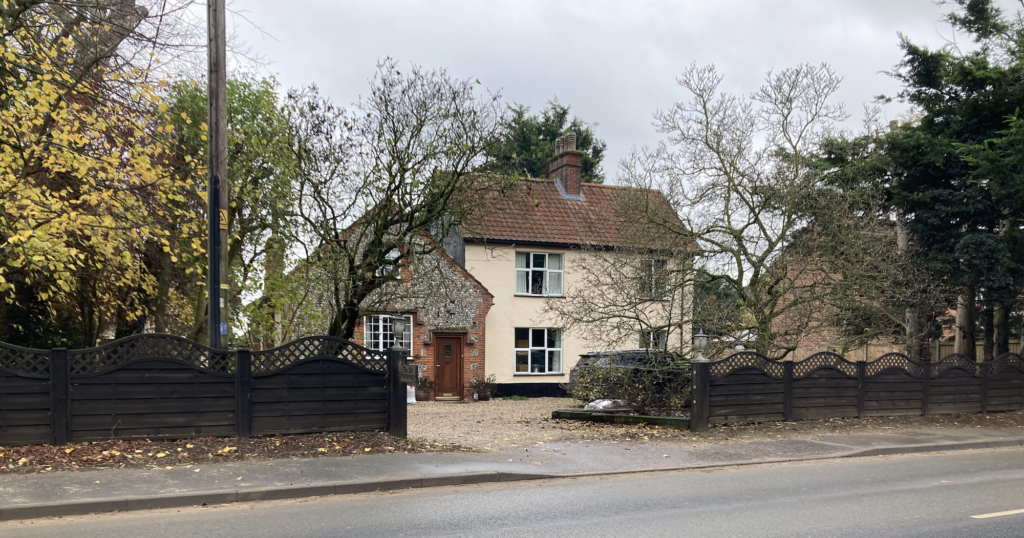
Next to the footpath and adjacent to the Attleborough Road was a house known as the Parsonage. This building was used by clergy who were often retired and on usually limited incomes, which they may have been able to supplement by helping in local churches.
The Parsonage House had what was known as the Parish Room adjoining. This was useful for providing a place where various village activities could take place.
Eventually both the Parsonage House and the Parish Room were sold by the church authorities which precluded further use by the public.
Between the Parsonage House, the Parish Room and the Great Ellingham School there were no further buildings on the offside of the Attleborough Road, at the early part of the 20th century.
In other articles, Harry Rix brings us along Church Street, Chequers Lane and Long Street.
Source:
‘Early Boyhood Recollections of a Great Ellingham by an Octogenarian’ Harry Rix. Huge thanks to Elizabeth Neil.