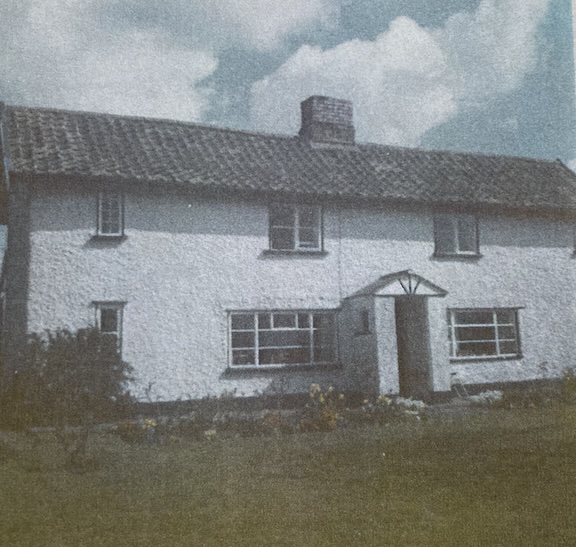
The Cottage formerly known as Hillside and now Owl Cottage at Stalland Common
Courtesy A. M.
Like many of the village’s historical houses, ‘Owl Cottage’ at Stalland Common was built as a double cottage. It is only in modern times that the house became one dwelling.
In Part I, we looked at some of the owners and occupiers of the cottage, from its construction around the mid-1830s to the early 1840s, through to the 1860s.
Here we take the history forward into the 1920s.
Electoral Registers & Census Returns
Without sight of any historical deeds, it can be difficult to establish who owned a particular property and who lived there. Unfortunately census returns are not always helpful as they do not consistently include exactly where a household is living in the parish.
Electoral registers can be helpful but (particularly before 1884), the data can be limited. It was not until the Third Reform Act of 1884 that there were significant changes to voting rights in the UK. This included the right to vote for men who occupied property or land with an annual rental value of at least £10. Consequently, their names appear in the electoral registers having previously been omitted. Of course, women were still excluded!
Nevertheless, using the electoral registers and the census returns, I am able to ascertain who most likely occupied the double cottage at Stalland Common from the 1880s. I am, however, struggling to find ‘firm’ names of the occupiers of the double cottage between the 1860s and 1880s.
In 1843, the double cottage was owned by Robert Large. I believe his eldest daughter Mary Ann West Large purchased the property (along with Brick Kiln Farm) in 1846. Mary married John Stedman in 1853 but retained ownership of the properties until her death in 1891.
1881 census
George Margetson
The 1881 census captures 45 year old widower and labourer George Margetson living at ‘Brick Kiln House’.
I am confident that the property is not the house later known as Brick Kiln Farm. At this time, farmer George Jude is the occupier of Brick Kiln Farm.
Three Marriages
With George Margetson are his two daughters, 17 year old Sarah Ann and 15 year old Susannah. They are both described as field workers. Also with the household are 29 year old Rebecca Thurston and 11 month old John. Rebecca is George Margetson’s step-daughter.
The census indicates that in 1881 the dwelling next to Margetson’s dwelling is unoccupied.
Margetson had a total of three marriages. He died in 1892.
John Dye & Henry Nurse
The Electoral Registers from 1889 to 1892 list George Margetson and Henry Nurse as occupiers of ‘Dwelling House’ ‘Brick Kiln’.
However prior to these dates, the same Registers shows John Dye has an occupier of ‘Dwelling House’ at ‘Brick Kiln’ for the period from 1885 to 1888.
1891 census
James George Reeder
At the time of the national head-count in 1891, James George Reeder and George Margerson are each occupying a similar three-roomed dwelling at Stalham [Stalling or Stalland] Road.
Born in Great Ellingham, James George Reeder is 24 and an agricultural labourer. With him is his 23 year old wife, Beighton born, Beatrice Rosetta nèe Trett. The couple had married in St James’s Church, Great Ellingham on the 18th December, 1890.
Farmer George Jude is still at Brick Kiln Farm.
Henry Thomas Nurse
The same census also shows 28 year old agricultural labourer Henry Thomas Nurse living in Hingham Road, along with his 26 year old wife Emily and their 3 year old daughter Harriet Mary. Henry Nurse was born in Sea Palling. Emily was born in Great Ellingham in 1864. She is a daughter of James and Rachel Beales.
Living nearby in a ‘Farm House’ are Henry’s parents, David and Caroline Nurse together with two of their children and a granddaughter. David Nurse is a farm bailiff.
Nevertheless, the dwelling occupied by David and Caroline Nurse is not Brick Kiln Farm, as the census (of 1891) clearly shows that George Jude is still at Brick Kiln Farm.
The Electoral Registers for 1893 and 1894 show James Reeder and Henry Nurse as occupying a ‘Dwelling house’ at ‘Brick Kiln’. By this time, George Margetson had died.
Moving forward, the 1895 and 1896 Electoral Registers show three occupiers of a ‘Dwelling House’ at ‘Brick Kiln’ as James Reeder, Henry Nurse and Alban Bass. From 1897 through to 1899, it is only Alban Bass and James Reeder.
1901 census
The 1901 census captures the households of Alban Bass and Henry Basham at ‘Brick Kiln Cottages”. Each dwelling comprise of 4 rooms.
Alban Bass
Widower 38 year old Alban Bass is living alone. Born in nearby Little Ellingham, Alban Bass is working as an ordinary agricultural labourer.
On the 8th October, 1892, at the age of 30, Alban had married 33 year old Thirza Houchen, the daughter of Perry Houchen, in the Parish Church at Little Ellingham. Sadly, Thirza Bass died in 1895.
Henry Basham
Mattishall born Henry Basham is 39. He is with his 38 year old wife Mary A and their children Sally 6 and George 4. Both children were born in Great Ellingham. Like Alban Bass, Henry Basham is working as an ordinary agricultural labourer.
James Reeder
James Reeder and his wife and three young children are still living nearby. The census gives the location of their 4-roomed dwelling as ‘Stalham Common’. Henry Nurse is also still living nearby with his wife and daughter in ‘Hingham Road’.
Walter Clarke
I believe that at this time, Brick Kiln Farm is occupied by farmer Walter Clarke.
1911 census
According to the Electoral Registers, Alban Bass continued to occupy a ‘Dwelling House’ at ‘Brick Kiln’ through to at least 1910.
The same Registers show that Alfred Dye and then James Groom also occupied ‘Dwelling House’ at ‘Brick Kiln’ during this period.
However the 1911 census lists several households occupying cottages at Stalland Common.
The schedule shows the Bowen household at Haw Farm with Skipper, Groom, Hurrell and Beales each occupying a nearby cottage. Next there is a farmhouse occupied by Key, and then the households of Bass and Macro.
Skipper, Groom, Hurrell & Beales
The farmhouse occupied by the Key family is Stalland Farm, which is on the opposite side of the road to Brick Kiln Cottages (now Owl Cottage). I believe that Skipper, Groom, Hurrell and Beales occupied those cottages which were once further along Stalland Common. These cottages (and Haw Farm) were later demolished.
Bass & Macro
I have no doubt that Alban Bass and Robert Macro were living at Brick Kiln Cottage.
Labourer Alban Bass is now aged 47. The census indicates that he has one child who is still living in 1911. 50 year old local woman, Mary Ann Ryder, is living with Alban as his housekeeper. Although single, Mary Ryder has had five children, two of whom have sadly died.
Tottington born Robert Macro is 59 and working as a shepherd. He has 34 year old single woman Lily Bowen living with him as his housekeeper.
1921 census
By 1920, Alfred Hall is occupying one of the Brick Kiln Cottages. The other is still occupied by Alban Bass.
Alban Bass
The census captures 58 year old Alban Bass along with his 69 year old housekeeper Mary Ann Ryder. Mary Ann is probably the daughter of Robert and Hannah Ryder [Rider]. Alban is still working as an agricultural worker. However his work appears to be on a casual basis.
Alban is several years away from being eligible for the ‘Old Age Pension‘, which was introduced in the UK by an Act of 1908. The pension was available to many people over the age of 70. However it was means tested and subject to certain other conditions.
Alfred Halls
Little Ellingham born Alfred Charles Halls is aged 28. His work as a general labourer is also on a casual basis. With him is his 21 year old wife Mary, Mary’s son Frederick George Eaglen aged 8, and their sons 3 year old Alfred John and 1 year old Herbert George.
By 1925, the Halls family had moved on, but Alban Bass remained living at the cottage until he died at the age of 63 in July 1925. Alban Bass was laid to rest in the churchyard of St James’s Church, Great Ellingham on the 23rd July, 1925.
Easlea Ownership
By the 1920s, the nearby Brick Kiln Farm is owned and occupied by the Easlea family. They also owned Brick Kiln Farm Cottages.
However in 1926, Easlea sold the double cottage to Taylor.
We continue to the story of the double cottage ‘Hillside’ in Part III.
Sources:
Norfolk, England, Register of Electors, 1832-1915. Ancestry.com. Norfolk, England, Register of Electors, 1832-1915 [database on-line]. Lehi, UT, USA: Ancestry.com Operations, Inc., 2016 Original data: England, Norfolk Register of Electors, 1844-1952. Salt Lake City, Utah: FamilySearch, 2013
Electoral registers 1832-1932. Constituency in full: Parliamentary County of Norfolk, Southern Division Constituency: P C of Norfolk, Southern Division Years: 1920-1931 Register type: Parliamentary CountyPolling district or place: Great Ellingham County: Norfolk Country: England Archive: The British Library Archive reference: SPR.Mic.P.18/BL.N.18 Record set: England & Wales, Electoral Registers 1832-1932 Category: Census, land & surveys Subcategory: Electoral Rolls Collections from: Great Britain, England
1881 census RG11/1974/85
1891 census RG12/1549/73
1901 census RG13/1867/72-73
1911 census RG14/11473/11-21
1921 census RG 15/9790, ED 5, Schs 58 & 60
Great Ellingham Parish Registers. Norfolk Record Office PD 609. Also available www.ancestry.co.uk, www.familysearch.org, www.findmypast.co.uk