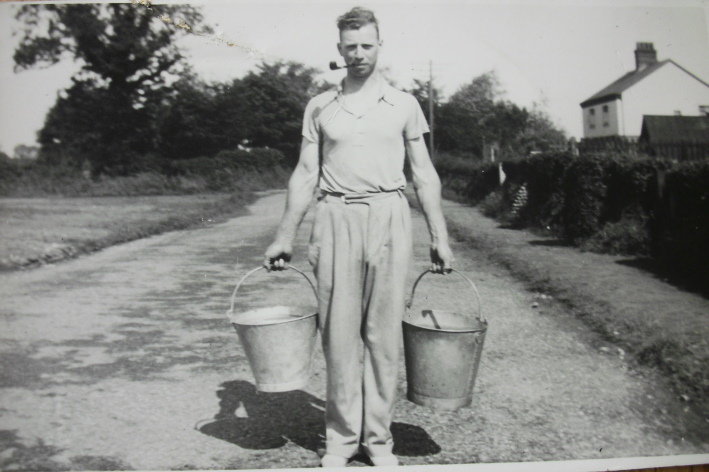
Louis Lebbell son of dairy farmer William Lebbell,
neighbours to Basil Jude, with pails of milk in Long Street c.1932
Photograph courtesy of Susan Fay
I came across the following interesting report published in the Daily Express of the 29th November, 1934 under the heading ‘The Farmer Who Sold Cheap Milk To The Poor‘. This was written by Joseph Meaney, a special correspondent with the Daily Express.
Sub-headings were ‘I HAVE BEEN SHADOWED’ and ‘ANGRY VILLAGERS TRYING TO PAY HIS PENALTY’
Milk Marketing Board
To put the report into context, I should explain that the Milk Marketing Board was established in October 1933. Its purpose was to create price stability, after a period when the British dairy market was in a chaotic state with overproduction of milk and extreme price volatility.
Accordingly, the Board had the power to set the price of milk, and to impose heavy fines and penalties to those farmers who disregarded the set price.
The Newspaper Report
ATTLEBOROUGH (Norfolk) Wednesday
The enforcement of a fine by the Milk Marketing Board has struck a blow at one of the most highly respected small farmers in these parts.

Mr Basil William Jude, of the Town Farm, Great Ellingham - a scattered village of 600 inhabitants two miles from here - has been ordered to pay a fine of £10.

Mr Jude omitted to make returns of his sales. His “crime” consisted of selling milk at two-pence a pint - a penny below the standard laid down by the board for the district - to poor people who could ill afford to pay more.

Judge Dumas, in Westminster County Court, made an order for this small farmer to pay the fine at the rate of 15s a month. It will therefore take more than a year for the penalty to be liquidated.

MORTGAGED FARM
Mr Jude has four cows. He lives with his wife and son in a thatched cottage on his farm. The son, who is twenty six years old, receives no wages - just a little pocket-money at the weekend.

Mr Jude has about thirty-five customers. At least a dozen are old-age pensioners, whose only income is 10s a week, out of which they have to pay rent.

Years ago Mr Jude kept twenty cows, but he has been forced to get rid of most of them. There is a heavy mortgage on his farm.

He carried the milk on his bicycle to the cottagers. He had no out-of-pocket expenses. That was why he could sell the milk below the price which the Marketing Board decreed.

But there was another, a humane, reason why Mr Jude refused to sell milk at more than twopence a pint. He would rather go out of business, get rid of his farm at a heavy loss, sell his stock - and, in fact, as he told me today, “be hanged first” - than sell it at a price he knows these poor people can ill afford to pay.

HIDDEN AGENTS
“I have been shadowed as though I had been guilty of some terrible crime”, he said to me. “I have had agents of the Marketing Board hiding behind a shed on my land.”

“The public do not understand the plight of people living in a poor agricultural district such as this. That is the pity of it”.

Mr Jude has not yet raised the price of his milk. He does not intend to put up his price to threepence a pint.

Four days ago he had to go to London to answer the summons taken out by the board to enforce the penalty. He had to journey overnight. He walked about until the county court opened its doors at ten o’clock the next morning. He could not afford to spend the night in a hotel.

The villagers of Great Ellingham are so incensed at the penalty which has been inflicted on him that an appear is going round for subscriptions to pay his fine.

His daily sale of milk averages six gallons. At the rate he is selling it brings him in 56s a week.

I went to the humble homes of some of the people Mr Jude has been supplying. Take the case of Jack Canham. He is a disabled ex-Service man. He was on war service from January 1915 to March 1919.

He has done no work for six and a half years. He lives with his wife and fourteen-year-old son in a cottage for which he pays a rent of 2s 8d a week.

THEY NEED MILK
He has a disability pension of ten shillings a week. He gets another ten shillings from his sick club.

His boy earns twelve shillings a week at a factory of which the lad gives up ten shillings for his keep. A total of 30s a week to keep a family of three.

This war veteran needs milk - plenty of it. It is the only thing that keeps him going.

If Mr Jude is forced to go out of business this ex-service man will have to cut down on his ration.

Then there is Mrs Ellen Elizabeth Fox. She is seventy-three, living in a tiny cottage for which she pays £8 a year out of her old age pension.

She is practically a prisoner. The last time she went out of her house was on April 11 last, and then it was only as far as the post office, a hundred yards or so away.

She practically lives on milk. She has had to ration herself severely since she lost her husband. She told me that if the price went up to threepence she would have to cut down her supply, which she said, even now was hardly enough for her requirements.

There is, too, an agricultural labourer, with a wife and five children, the youngest four years old. His wage is thirty shillings a week - when he is working full time - less ninepence for stamps. All that this family can afford is a pint of milk a day.

That is the story of this poor Norfolk farmer.
Basil Jude’s story was published nationwide. I found two other references to the case.
Published in the Daily Herald on Tuesday 27 November 1934:
MILK BOARD FINE ENFORCED
Judgment was given against Mr Basil William Jude of the Town Green Farm, Great Ellingham, Attleborough, Norfolk, when he appeared at Westminster County Court yesterday on a Milk Marketing Board summons to enforce a penalty of £10 which the Board had imposed upon him.

Mr Judge told the judge “Mine is an agricultural district, where the wage is only 30s [thirty shillings] a week and people can’t afford to buy much milk at the present price”.
and in the Shepton Mallet Journal on Friday 30th November, 1934:
PLIGHT OF SMALL FARMER

When Basil William Jude, of the Town Farm, Great Ellingham, Attleborough, Norfolk, appeared at Westminster County Court, Monday, on a Milk Marketing Board summons to enforce a penalty of £10 which the Board had imposed upon him, he said he kept only four cows.

Mr Graham Dixon, for the Board, said the exemption of milk producer with four cows applied only to those not selling milk by retail, or selling it only to their servants for consumption by their households.

Judge Dumas said Mr Jude had no answer to the case, adding, “Some day or other I hope you will reap the benefit of the scheme. With all the schools now having milk compulsorily there will be greater demand”.

Mr Jude: Mine is an agricultural district where wage is only 30/- a week, and people can’t afford to buy much milk at the present price.

Judge Dummas: I have to enforce the fine, provided you have not resorted to arbitration.
Mr Jude: I can afford only 10/- a month.
Mr Dixon: We are prepared to accept £1.
Judge Dumas: Fifteen shillings.
Challenging Village Life
This 1934 account of a small farmer’s plight in Great Ellingham provides us with a small insight into the lives of the people in the village at that time. We learn that for many of the 600 or so occupants life is challenging.
Basil Jude provides milk to some 35 customers. Of those 35, around 12 are ‘old-age pensioners’. Their income is limited to the standard state pension of 10 shillings a week (that’s 50p in decimal terms). I have no doubt that these ‘old age pensioners’ are all over 70, and in receipt of the non-contributory state pension, which was also means-tested.
The report names two of the villagers. Jack Canham is a disabled ex-service man is living with his wife and son. Old age pensioner Ellen Elizabeth Fox is 73 and is living in a ‘tiny cottage’. There is also an unnamed agricultural labourer who has a wife and five children. His wage is thirty shillings a week (equivalent to £1.50 in decimal terms).
Who is Basil Jude?
Brick Kiln Farm
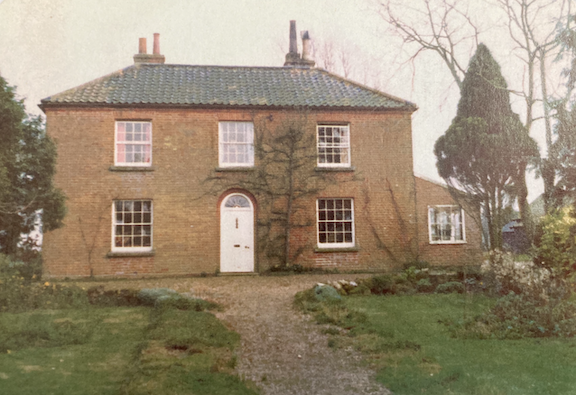
Brick Kiln Farm. Courtesy Jon & Fran Elliott
Basil William Jude was born in Great Ellingham on the 23rd July 1882. He is the youngest of three sons born to George and Mary Jude. I am confident that Basil was born at Brick Kiln Farm in Hingham Road, where his parents and brothers have been living since at least 1881.
The 1891 census captures 8 year old schoolboy Basil with his parents and brothers at Brick Kiln Farm. 47 year old Garvestone born farmer George Jude rents Brick Kiln Farm from Mary Ann Stedman, whose father had previously owned the farm.
Rookery Farm
By 1901, Basil is with his parents and brother George at Rookery Farm. Presumably 18 year old Basil and 31 year old George are working for their father.
Marriage
In 1905, Basil marries Besthorpe born Ada Emily Wigby. Ada is a daughter of Obadiah and Louisa Wigby who, by 1904, are living in Great Ellingham.
Bow Street
The 1911 census captures 28 year old farmer Basil Jude with his 29 year old wife Ada occupying a two-roomed dwelling in Bow Street, Great Ellingham. The couple have a four year old son, Basil Jnr.
Basil’s elder brother Charles and his wife Elizabeth are neighbours at Walnut Farm.
Kenninghall
By 1921, Basil, Ada and Basil Jnr are in Kenninghall. At 38, Basil is still farming and is also an employer. Basil Jnr is now aged 14 and is assisting his father with general farm work. However Basil and Ada’s time in Kenninghall is short. Before 1923, they moved back to Great Ellingham.
Back to Great Ellingham
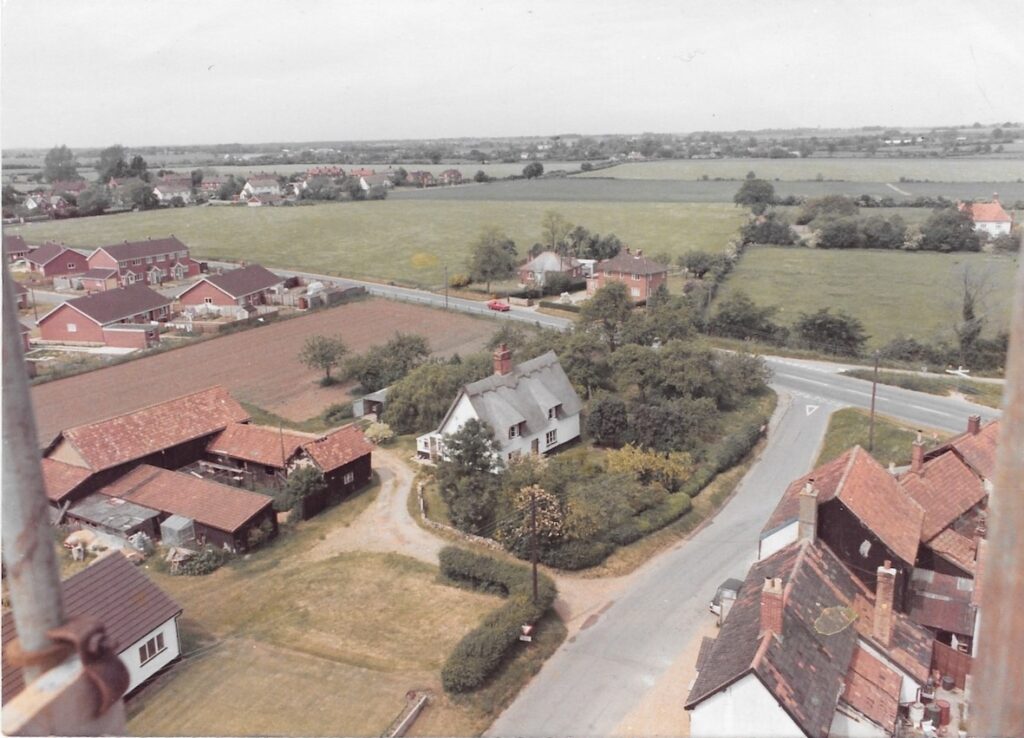
Church Farm. c.1974. Courtesy Bob Cobb
The Electoral Register for 1923 lists Basil and Ada in ‘The Street’. At this time, Basil’s brother George is farming Church Farm in Church Street (often referred to as ‘The Street’). George and Basil’s parents, George and Mary Jude, are also at Church Farm. I think it likely that Basil and Ada are also living at Church Farm.
The Electoral Registers show that Basil and Ada continue to live in ‘The Street’ until around 1933.
Kelly’s Directory of 1933 lists Basil Jude, farmer, Town Green; Charles Jude, farmer, Walnut Farm; George W Jude Jnr. Church Farm.
The newspaper account of 1934 gives Basil’s address as ‘The Town Farm’, Great Ellingham. I assume ‘The Town Farm’ to be near to what is today known as Town Green Farm, at Town Green (near Long Street). Basil is still listed as being at ‘Town Green Farm’ in 1937.
We glean from the newspaper report that Basil lived with his wife and son in ‘a thatched cottage’ on his farm. We are also told that his son (Basil Jnr) is 26 years old, and receives no wages, save for some pocket money at the weekend.
In 1936, Basil Jnr marries Lilian Hudson. The 1939 Register finds Basil Jnr and his wife Lilian and their two children living in one of the ‘new’ council houses in Hingham Road.
The same 1939 Register finds Basil and Ada with the household of Basil’s eldest brother Charles and his wife Elizabeth, at Walnut Tree Farm in Bow Street. Charles Jude has retired from farming. Basil is now working as a general labourer in agriculture. Accordingly, it seems that Basil eventually ‘gave up’ the farm.
Deaths of Ada & Basil Jude
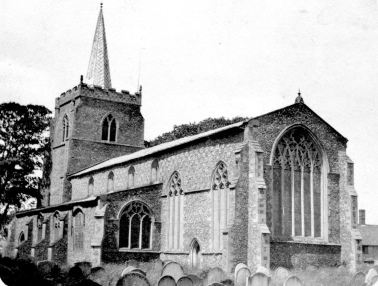
Church of St James, Great Ellingham
Ada Jude died in the summer of 1942 and is buried in the churchyard of St James. Basil Jude died on the 17th October, 1956, at Pulham Market, where he is buried.
Sources:
https://collection.sciencemuseumgroup.org.uk/people/ap32638/milk-marketing-board accessed 09.09.2026
https://sustainablefoodtrust.org/news-views/explaining-britains-dairy-crisis/ accessed 09.09.2026
https://elmbridgemuseum.org.uk/online-exhibitions/milk-the-milk-marketing-board-and-the-milk-crisis/ accessed 09.09.2026
1939 England & Wales Register. The National Archives; Kew, London, England; 1939 Register; Reference: RG 101/6590H Ancestry.com. 1939 England and Wales Register [database on-line]. Draper, UT, USA: Ancestry.com Operations, Inc., 2018.
Find a Grave website. Basil William Jude 1882-1956
Find a Grave website. Ada Emily Jude 1881-1942
GRO Index. Also available on FreeBMD website
1891 census RG12/1549/73
1901 census RG13/1867/73
1911 census RG14/11473/40
1921 census RG15/9792 ED 10, Sch 219
Kelly’s Directories 1933 and 1937
England & Wales Electoral Registers 1832-1932. Southern Division, Great Ellingham. The British Library. Viewed via FindMyPast.
29 November 1934 Daily Express
27 November 1934 Daily Herald
30 November 1934 Shepton Mallet Journal
Newspapers viewed via The British Newspaper Archive