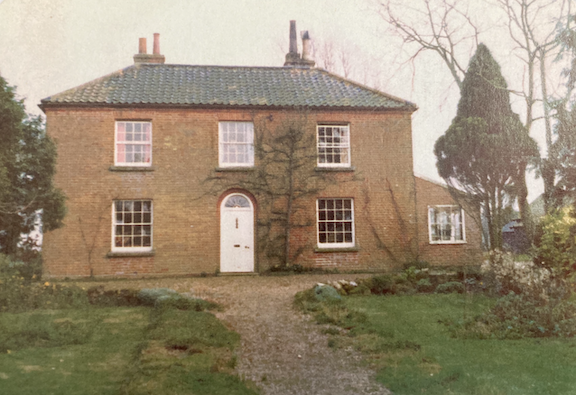
Brick Kiln Farm
Courtesy Jon & Fran Elliott
Great Ellingham is fortunate to have several interesting historical houses. Some are ‘tucked away out of sight’, but others are visible from the village roads.
Road to Hingham
The route of many of these roads has changed little over several centuries. They have evolved from a time well before the invention of the motor vehicle. Although some of the roads have been widened over the years, many of them are still quite narrow.
The road to Hingham (Hingham Road) is a well established highway. I have no doubt that a large number of Great Ellingham residents have passed along this road to the nearby small market town of Hingham.
In the times before the motor car, these individuals or families will have walked the 3 miles to Hingham, or travelled by horse – with or without a cart or carriage. Some may even have cycled the distance – and, maybe, still do today!
‘Georgian’ looking House
The delightful property known today as ‘Brick Kiln Farm’ sits slightly back from the highway along the Hingham Road. I am confident that, like many individuals in the past, people travelling along the Hingham Road will notice the wonderful ‘Georgian’ looking house. It sits on the eastern side of Hingham Road – not far from another much older property, Manor Farm.
The ‘look’ of Brick Kiln Farm boasts some of the characteristics of Georgian architecture. The appearance is balanced, it has sash windows as well as an arched fanlight. However was the house erected during the Georgian period (1714-1830) or, later, during the Victorian era? Like many older buildings, the house will have undergone many changes over the years.
When was Brick Kiln Farm built?
Brick Kiln Farm did not exist before at least the late 1830s.
Before 1800, the Reverend George A Thomas owned over 22 acres of land together with a house, barn, stable and yard, not far from where Brick Kiln Farm was later built.
This earlier house was subsequently owned by his son, the Reverend John Thomas. The Thomas family continued to own the property until John Thomas sold it to Robert Large. Unfortunately I do not know exactly when Robert Large purchased the property from John Thomas. Was the present Brick Kiln Farm built during John Thomas’s ownership or during the tenure of Robert Large?
Large died on the 21st September, 1843. He left his farmhouse with the outbuildings, yards, gardens and around 44 acres of land to his eldest daughter Mary Ann West Large. However this legacy is limited to 3 years. Large also states that he had lately purchased this land and premises (along with a cottage in two dwellings – today known as Owl Cottage) from John Thomas.
The Great Ellingham Tithe documentation of December, 1843, shows Robert Large as the owner of a house and premises in Hingham Road. The house is occupied by Mary Ann Large. The associated tithe map identifies this property to be Brick Kiln Farm, and not the earlier farmhouse. Indeed there is no reference to the earlier house. I assume here that reference to Robert Large will be Robert Large the Younger who (along with his elder brother William), is an executor of his late father’s estate.
It follows that the present building Brick Kiln Farm was built at some point from the late 1830s to 1842 i.e. during the early Victorian period.
Robert & Susannah Large
I have no doubt that Robert and his wife Susannah occupied Brick Kiln Farm, albeit that it may have been for a short time, before Robert Large’s death in 1843.
Mary Ann West Large
As mentioned, Robert Large left Brick Kiln Farm to his eldest daughter Mary Ann West Large, subject to a three year lease at an annual rent of £70. This was also subject to Mary’s mother, Susannah, occupying one upper floor room.
Indeed the Great Ellingham Tithe documentation of December 1843 shows Mary Ann Large as the occupier of Brick Kiln Farm (house and premises), some 22 acres of arable and pasture land, as well as the nearby double cottage.
End of Lease
Around three years after the death of Robert Large, arrangements were put in place to sell all his property and land in accordance with his will. Large’s property and land were divided into 8 Lots. An auction is arranged for the 19th June, 1846 at the Griffin Inn, Attleborough.
Lot 1 comprise:
An Excellent New-built Brick and Filed FARM HOUSE, fit for the reception of a respectable Family, with Barn, Stables, Cow-house, Granary, Cart-lodge, and other requisite Outbuildings, and five Inclosures of very productive Arable and Pasture Land, well-fenced, lying immediately around the Premises, containing together 11A 1R 29P.

This Lot is now in the occupation of Miss Mary Large, is pleasantly situated, abutting upon the high road, leading from Attleboro' to Hingham, adjoining Lots 2, 3 and 4 and Lands, the property of John Mendham Esq. Freehold
Lot 2 comprise the nearby double tenement (now Owl Cottage) with Lots 3, 4, 5, 6 & 7 being arable or pasture land and Lot 8 a new-built freehold messuage (later known as Primrose Farm off Long Street).
I have no doubt that Lot 1 is Brick Kiln Farm.
New Owner
Historical deeds to Brick Kiln Farm suggest that Mary Large purchased all the property and land, but possibly with the exception of Lot 8. She continued to occupy the property.
1851 census
The national head-count of 1851 lists 51 year old unmarried Mary Ann Large as a farmer of 43 acres at Stalling Common, Great Ellingham. With Mary is her 76 year old widowed mother and annuitant, Susanna Large.
Mother and daughter have two servants, 15 year old house servant Frances Brown and 33 year old farm servant James Howard. Farm labourer, 28 year old James Rushbrook is lodging with them.
Although the household is listed as being at Stalling Common, I have no doubt that Mary Ann Large is the head of the household at Brick Kiln Farm.
Marriage
On the 12th May, 1853, 53 year old spinster Mary Ann West Large marries farmer John Stedman, some five years her junior. Mary’s brother Robert and sister Eliza are witnesses to the marriage.
Following the marriage, John and Mary Stedman lived at Brick Kiln Farm. Unless prior to her marriage Mary made a contract to retain her rights and control over Brick Kiln Farm, upon their marriage John Stedman would automatically gain control of the property.
1861 census
The 1861 census captures 55 year old Suffolk born John Stedman with his 60 year old wife Mary Ann at a farm in Hingham Road. The couple employ one man and one boy, as well as a 14 year old general servant, local girl Martha Houchen. I have no doubt that they were at Brick Kiln Farm.
1871 census
The 1871 census lists John and Mary Ann Stedman in Hingham Road. The couple, now aged 61 and 67 respectively, are still farming some 43 acres. Their general servant is 15 year old Eliza Hunt.
Death of John Stedman
On the 6th October, 1877, John Stedman died at the age of 71 in Great Ellingham – presumably at Brick Kiln Farm.
Following her husband’s death, it seems that after occupying the house since at least the 1840s, Mary began to make arrangements to leave Brick Kiln Farm.
Auction
On Saturday 27th October, 1877, the Norfolk News published a notice concerning the auction of certain agricultural items belonging to the late John Stedman. The auction is set for Thursday 1st November, 1877, at Great Ellingham – again, presumably at Brick Kiln Farm.
The items included two horses, six young steers, single-breasted wagon, two tumbrils, ploughs, harrows, bins, troughs and harness.
John Stedman’s Will
John Stedman, farmer of Great Ellingham, made his last will & testament on the 27th April, 1858. He left all his real and personal estate to his wife, Mary Ann West Stedman, absolutely. This included any interest John Stedman had in Brick Kiln Farm and the nearby cottage in two tenements (now Owl Cottage).
1881 census
The national head-count of 1881 captures 81 year old widow Mary A W Stedman living in Chapel Street, Hingham. With her is 19 year old domestic servant Emily Hallock.
Jude Occupies Brick Kiln Farm
The same census captures 37 year old Garvestone born George Jude at a farm in Hingham Road, Great Ellingham. George Jude is farming some 44 acres. With him is his 34 year old wife Mary and sons Charles 13 and 11 year old George. I am certain that George Jude is at Brick Kiln Farm.
Nevertheless, the property continues to be owned by Mary Ann West Stedman.
Mortgage to Hughes
On the 21st February, 1877, Mary Stedman borrows £350 from David Watkins Hughes. The mortgage (plus interest) is secured against Brick Kiln Farm.
On the 17th August, 1889, Hughes transfers the mortgage (of £350) to William Partridge Cubitt, a farmer, miller and merchant of Bacton. Mary also borrows a further sum of £550. The sum of £900 plus interest is now secured against Brick Kiln Farm.
Death of Mary Stedman
On the 24th February, 1891, Mary died at the grand age of 90 at Southburgh.
Mary’s will was proved on the 17th June, 1891, by her sister, Harriet Johnson, the wife of Ezekiel Johnson of Southburgh, and her nieces, Susannah Mary Edmonds, the wife of William Theophilus Edmonds of Hingham, and Ellen Large Smith, the wife of William Partridge Smith of Wicklewood.
1891 census
During this time, George Jude continues to occupy Brick Kiln Farm. The 1891 census lists 47 year old farmer George Jude at Brick Kiln Farm along with his 47 year old wife and sons Charles 23, George 21 and 8 year old Basil.
However by 1901, George Jude has moved to Rookery Farm.
New Owner George Baly
In 1902, after being owned by members of the same family for some 60 years, Brick Kiln Farm and the nearby double cottage, were sold to George Baly.
The story of the owners and occupiers of Brick Kiln Farm continues in Part II.
Sources:
Mary Ann West Stedman, England & Wales National Probate Calendar (Index of Wills & Administrations) 1858-1995. Principal Probate Registry; London, England; Calendar of the Grants of Probate and Letters of Administration made in the Probate Registries of the High Court of Justice in England. Ancestry.com. England & Wales, National Probate Calendar (Index of Wills and Administrations), 1858-1995 [database on-line]. Lehi, UT, USA: Ancestry.com Operations, Inc., 2010
Private Deeds Collection. Thanks to Jon & Fran Elliott
Will of Robert Large of Great Ellingham. Norfolk Record Office. ANF will register 1842-1844 fo. 381 (1843 no.76) Microfilm MF 250. Viewed at the Norfolk Heritage Centre, Millennium Library, Norwich. Reel GS 0167180.
Great Ellingham Parish Registers. PD 609. Norfolk Record Office
1802 Russell James Colman Plans. Great Ellingham. Norfolk Record Office. Catalogue Ref. C/Ca 1/84.
1799-1842 F W Horner, Records of the Surveyors to Commissioners for Inclosure in Parishes in Norfolk and Suffolk. Great Ellingham (Act 1799). Norfolk Record Office. Catalogue Ref: NRO, BR 90/2
1800 Inclosure Commissioner’s Particulars and Valuation, Great Ellingham. Norfolk Record Office. Catalogue Ref: NRO, MC 2213/119
1799 Statement of Claims. Great Ellingham Inclosure. Norfolk Record Office. Catalogue Ref: MC 2213/118
Great Ellingham Tithe Map 1843. Tithe Apportionments, 1836-1929 [database online]. TheGenealogist.co.uk 2023. Original data: “IR29 Tithe Commission and successors: Tithe Apportionments” The National Archives
1851 census HO107/1823/117
1861 census RG9/1237/82
1871 census RG10/1841/81
1881 census RG11/1974/85, RG11/1955/54
1891 census RG12/1549/73
27 October 1877 Norfolk News
24 October 1877 Norwich Mercury
6 June 1846 Norfolk News
Newspapers viewed via The British Newspaper Archive website