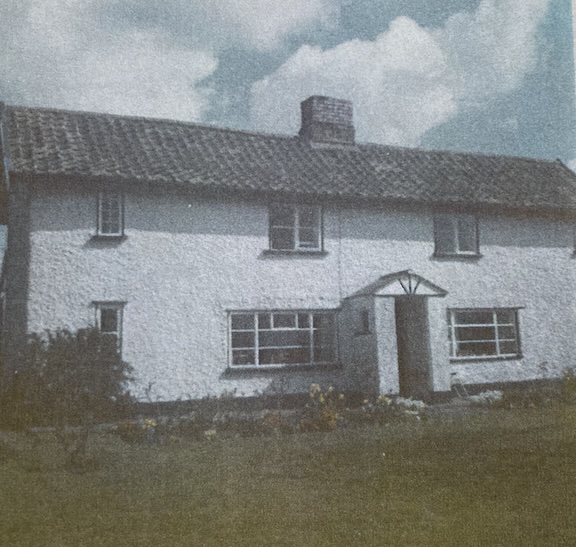
The Cottage formerly known as Hillside at Stalland Common
Courtesy A. M.
In 1981, Watsons Estate Agents refer to a house named ‘Hillside’ in Great Ellingham as a ‘picturesque detached period cottage”.
Their description includes:
"The property has period features including exposed beams, and construction is part brick, part clay lump on a timber frame under a pantiled roof. Originally two cottages and converted some years ago to provide a very pleasant character cottage in lovely surroundings."
At a similar time, Potter & Co., Estate Agents’ description of the house includes:
"This clay lump and brick cottage was originally built over 200 years ago and has been modernised sympathetically to retain its charm and many old beams..."
Origins
In Part I, we established that the house was built as a double tenement between the late-1830s and the early 1840s. We also looked at some of the owners and occupiers of the dwelling through to the 1860s.
Moving Forward
We then ‘took’ the property forward to the 1920s in Part II.
Here we particularly look at the ‘family home’ from around the 1950s. But first, we pick up at the time of the death of Alban Bass.
In the 1920s, Hillside was still in two tenements. Likely each dwelling comprised a ‘two up two down’. Alban Bass lived in one of the tenement from at least 1895 until his death in 1925.
At this time, Hillside was owned by William and Edna Easlea, who also owned Brick Kiln Farm. Indeed, Hillside has always been owned by the same individuals who owned Brick Kiln Farm until it was ‘sold off’ in 1926.
In the June of 1926, Easlea sold Hillside to Taylor. William and Edna Easlea remained living at Brick Kiln Farm. Within a few months, Taylor sold Hillside to Matsell for £100.
In 1932, Matsell sold to Dunthorne. The purchase price was then £250. Dunthorne remained the owner of Hillside for most of the duration of WWII.
However in 1944, Dunthorne sold Hillside to Saunders for £300.
I do not know whether any of these owners occupied all or part of the property.
Family Home
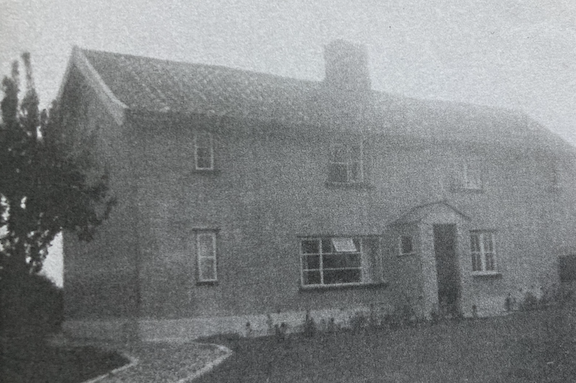
The Cottage formerly known as Hillside at Stalland Common.
Courtesy A. M.
Nevertheless in 1951, Mrs Saunders sold Hillside to Harry Jeffery. It is then that the property became the family home of Harry’s son, Horace with his wife and their two daughters, who were both born and raised at Hillside.
We are fortunate to have the memories of one those girls.
The Outside of Hillside
Hillside was west facing and situated on a slope overlooking a tiny stream which flowed south and, eventually, into the river Thet. From our windows we could see Little Ellingham on the far side of the valley and at night the sky would light up with flashes from the Battle Area [Stanford Training Area].
There were meadows between the house and the stream which which were used for grazing horses. We played in these meadows during the periods when the horses were not there.
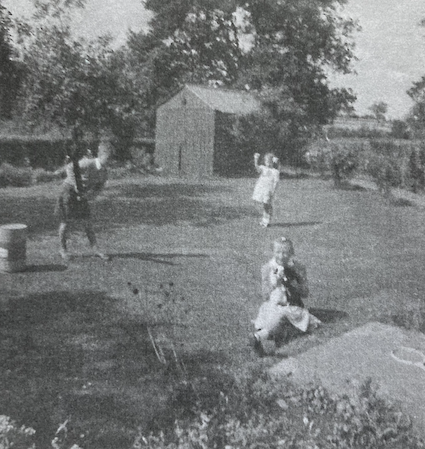
Fun in the garden at ‘Hillside’
Courtesy A.M.
Dry Pit surrounded by Thicket
Not far from the house on the west side there was a dry pit surrounded by a thicket with an oak tree. It is possible that the 'clay and lump' used in the construction of Hillside came from this pit.
It was eventually ploughed over and became part of a bigger field.
Pattern of Small Fields & Hedges
To the south of Hillside, I remember a pattern of small fields and hedges. The hedges of Hillside itself were part of this pattern - they continued onwards in their different directions. [Later, these hedges were removed and the ditches filled in]
Stalland Farm
To the north of Hillside, on the other side of the road, lay another small-holding - Stalland Farm (also known as Stallard Farm). During the war it was used by the military. An extra room was built on the front which was used as an office [now demolished].
East Side
There was no land at the back of the house [east side], just enough for a path and a small flower bed outside the kitchen window. There were two large red-flowering currant bushes and lilies-of-the-valley by the path. "War-Time' plans included lupins and a red-flowered climbing rose named 'American Pillar'.
A previous occupant (some twenty or thirty years before us), had the foresight to plant fruit trees in the garden at Hillside and we were the fortunate beneficiaries.
An 'ash' path ran from the kitchen door to the road, made up of ash from the fire. This made a little short cut and was used by the tradesmen i.e. Mr Semmence the butcher from Hingham, Mr Hardy the grocer from Deopham, the fishmonger and Mr Scase the baker from the Mill in Great Ellingham. In the early days, travelling salesmen still called occasionally selling shoe cleaning polish etc.
Well by the Swing
Dad suspended a swing for us from a large tree by the front hedge. The well was by the swing, at one end of the rockery, securely covered by two thick concrete slabs. By the time we went to Hillside, mains water was supplied to the house from the supply which ran up to the airfield.
Small-holding
Horace Jeffery had a small-holding which took in a small area of derelict ex-airfield land comprising the site of the guardroom, lookout tower and the remains of various buildings. Amongst the variety of animals kept by Horace Jeffery were pigs, geese and chickens. Together with their garden, the Jeffery family had an abundance of plums, pears, apples, blackcurrants, gooseberries, raspberries, strawberries, rhubarb, potatoes, onions, runner beans, carrots, beetroot, radishes and so on.
The Interior of Hillside
Our narrator goes on to describe the inside of the house:
Nobody ever used the front door until well into the 1970s except Mr Fox the policeman who came annually to check Dad's books [financial records]. The front door had a small open porch with a wooden seat. The front door knocker was a metal version of the Cutty Sark. This was left behind when we moved out.
The kitchen door was on the north side. At first there was a shed and a dog kennel for our dog, Rory, by the kitchen door. Entrance was via a small wooden porch, later replaced by a "conservatory" housing a table and chair where Dad had his morning coffee. The telephone, when it arrived in the 1960s, was placed out here.
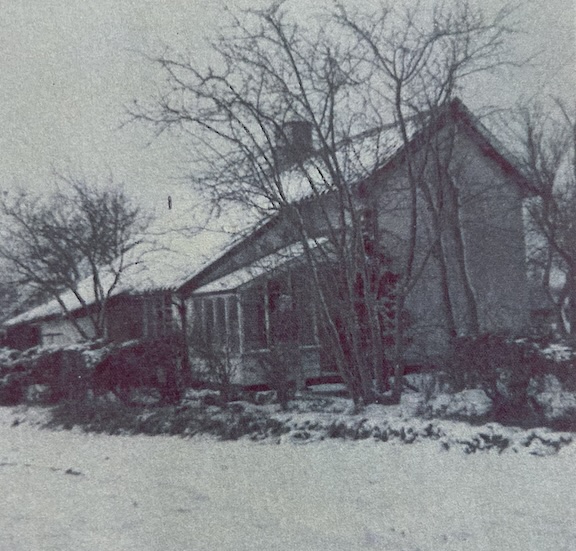
‘Hillside’. Courtesy A. M.
Kitchen
The galley kitchen was Mum's domain. In those days, the main meal was at lunch-time, which we called dinner. Like many other women, Mum made the Sunday roast stretch well into the next week. Tea was more of a 'high tea' e.g. scrambled eggs or cod's roe with bread and butter. Saturday was always 'baking day'.
Electricity came to Hillside when I was about two or three years old as I can remember great thick black rubber cables being nailed to the walls. As the '60s rolled on, as well as the electric cooker, an electrically powered washing machine (with hand-turned wringing mechanism above) appeared in the corner of the kitchen and later a fridge. An airing cupboard was in the far corner with an immersion heater to supply hot water in the summer.
Living Room & Pantry
From the kitchen there was one step down into the living room (the stairs were immediately on the right, behind the door). Our lives centred around the dining table.
A door led to a small room which extended under the stairs on the north side of the house which we called the Pantry. This was a very cold room with a stone floor. It was completely shelved out and had a large shelf extending across from side-to-side. This is where Mum stored all her home-made jams, marmalade, bottled fruit and ginger beer. Occasionally a pheasant would hang from a hook.
Eventually Mum and Dad decided to have the living room made bigger and had the wall between the living room and pantry demolished. This revealed the original 'wattle & daub' construction. Mum had the old 'range cooker' taken out of this room. She put in a red brick fireplace with a red tiled mantle-piece. A 'back boiler' supplied the ot water system in winter.
Front Room
A door from the living room led to a small lobby at the front door which in turn led into the "front room" which was kept for 'best'. A three-piece suite and a piano were somehow crammed into this tiny room, leaving a small gap to enable access to the bathroom. At Christmas, the tree stood in the corner of this room and the room smelled of cigarette smoke from visitors. (Just before they left Hillside, my parents had another staircase made and the bathroom door relocated.)
In the opposite corner of the room was a small lobby. From it, one door led to the outside 'wash-house' and another door led into the bathroom which had been fitted across the south end of the room (all now demolished). There was hot and cold running water. However there was an additional cold tap on the bath which supplied rain water from the butt on the outside south-west corner of the house.
Wash-house
The wash-house had a door leading out to the garden on the south side. It was a large space, open to the roof and had the original copper in the corner by the outside door for laundry. This was a brick-built arrangement in which a fire would be laid underneath to heat up the water in the copper. I never saw the copper in use as Mum did her laundry in the kitchen in the new electric washing machine.
Outside Lavatory
The door from the wash-house led outside to another water butt, the wood shed and the remains of a demolished 'clay lump' building which had disintegrated into a heap. A path led round the back of the house (on the east side) firstly to the coal shed and then what was originally the outside lavatory by the kitchen window. In our time it was used as a garden shed but the wooden seat was extant. There was a small square cut out of the bottom of the door to provide light.
Bedrooms
Access to the bedrooms was from the staircase behind the door in the living room. Mum had 'improved' the look of the two doors in the living room by papering them and applying a thick layer of paint or varnish to make them look like dark brown wood rather than pine. This process is called "scumballing". Mum had also been responsible for taking down the ceilings and exposing and painting the beams.
The staircase led to a tiny bedroom on the landing and then to Mum and Dad's bedroom. A door-way (above the front door) led to my bedroom. Another door led to another bedroom at the south end of the house. Part of this room disappeared to make room for a new staircase.
End of an Era
The Jeffery family lived at the cottage at Stalland Common for 30 years. In 1981, Horace and Rhoda Jeffrery left Hillside when they sold the property to the Kimber family.
Under the new owners, the house underwent further changes including ‘modernisation’ and the removal of the red brick fireplace which had been installed by the Jeffery family.
The delightful ‘old’ cottage continues to be a family home.
Sources:
Huge thanks to A.M. for the wonderful memories of her time at Hillside