In the past, property ownership was proven through a bundle of title deeds. These were handwritten paper documents which are then passed down from owner to owner. Today one still has to prove ownership to a property but, with the modern land registration system, it is usually much simpler to do.
Historical deeds record details of the land and/or property as well as identifying the seller, buyer, lender etc. Many deeds will also recite the names of the occupiers, as (before relatively modern times), very few properties were owner occupied.
So far, I have not come across any historical title deeds to the house at the corner of Long Street and Penhill Road.
Accordingly, I have had to look at other sources to piece together some of the history of the owners and occupiers of this property. For example, the Great Ellingham Inclosures documentation c.1800, surveys of the village c.1817-1830s, Great Ellingham Tithe map and schedules dated December, 1843, census returns and oral history.
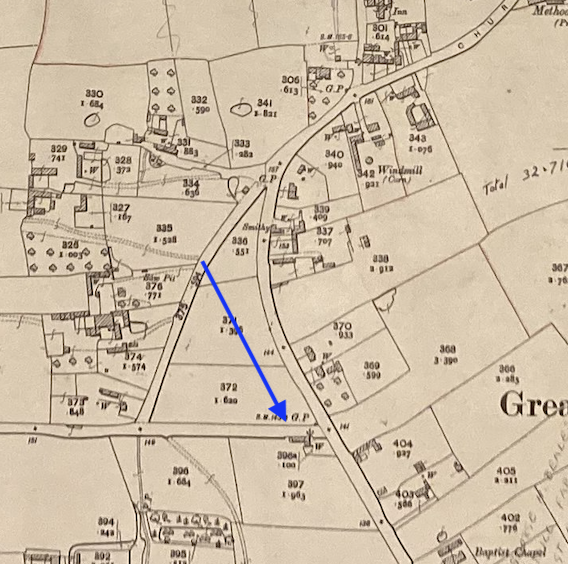
Extract from 1906 Ordnance Survey Map. Second Edition. Surveyed in 1881. Revised 1904.
The arrow on the above map shows the location of the dwelling in Long Street at the corner of Long Street and Penhill Road. At some point, the house became known as ‘Redlands’.
I have managed to piece together some of the early history of the house, but have yet to find evidence of the names of the owners or occupiers of the house after the 1840s. However, I have discovered some of the occupiers in the 20th century.
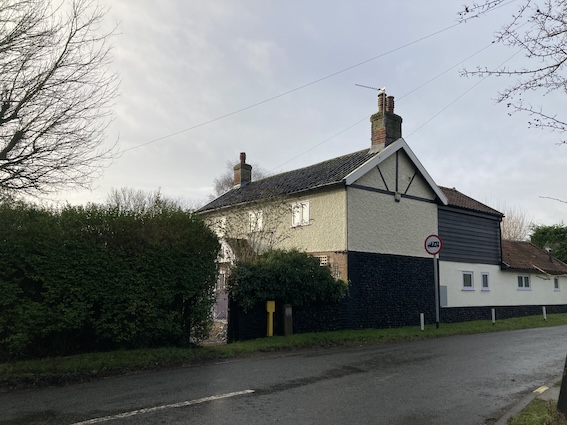
The Dwelling in Long Street at the corner with Penhill Road which was once owned by Howe.
Photograph taken January 2026
We begin at the turn of the 19th century.
Great Ellingham Inclosures c.1801
This house did not exist at the time of the Great Ellingham Inclosures c.1801.
At this time, the land on which the house was built was ‘an allotment on Town Green’. The allotment measured one acre, three roods and 26 perches (1a 3r 26p). It was owned by James Long who also owned a cottage with garden (as well as an adjacent garden), at the very far northern end of Long Street – where it meets Church Street.
James Long
The allotment on Town Green was awarded to James Long in 1802 by the Commissioners acting under the Great Ellingham Inclosure Act. It was previously common land with communal rights.
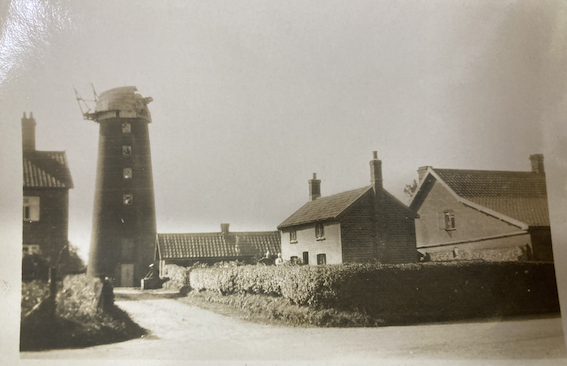
A later photograph of the Mill, Mill Cottage and the Post Office.
Courtesy Angela Campbell-Roberts
I am confident that James Long’s cottage is the dwelling which became known as Mill Cottage. The additional adjacent garden is the land on which the present Post Office was later built.
I believe that after c.1800 but before 1805, John Howes became the owner of James Long’s property and the allotment. I do not know whether it was John Howes who commissioned the building of the house on the allotment or the earlier owner, James Long. In any event, I believe the house on the allotment was built before John Howes died.
John Howes
John Howes married Rhoda Barnard in the Church of St James, Great Ellingham on the 29th June, 1802. His full names is recorded as John Gilman Howes.
Given that in his will, John Howes describes himself as a butcher, he may well be the ‘John Howes’ who was apprenticed to butcher Joseph Markham in Little Ellingham in 1785. John may have been aged between 10 and 14 in 1785 (giving a birth year of between 1771 and 1775). However, it is possible that he was a little younger.
In any event, he would have needed to complete his apprenticeship (usually seven years) before entering into a marriage.
Just over three years after he married, John Howes died. He was possibly only in his early thirties.
On the 19th December, 1805, John Howes was buried in the churchyard of St James. In his will, John Howes appoints his brother in law, James Barnard (of Bury Hall), as his executor.
I have not (yet) investigated John Howes’ will. Nevertheless, I think it likely that he left Rhoda at least a life interest in their house at the very northern end of Long Street. This life interest may also have been limited to Rhoda remaining his widow.
1817-1819
A Survey of the village dated 1817-1819, shows Rhoda Howes as the owner of the house and garden at the far northern end of Long Street (later known as Mill Cottage). However, this is now occupied by Robert Poll.
The cottage and garden built on the former allotment land (the subject of this article) is owned by James Barnard as executor of Howes. It is occupied by William Leeder.
This ownership and occupation continues into the 1830s. However in 1831, John Howes’ widow, Rhoda Howes, marries Joshua Potter in Great Ellingham.
It also appears that by the 1830s, the house built on the allotment upon Town Green is now occupied by William Rider.
The Great Ellingham Tithe documentation dated December 1843, shows William Rider (Ryder) to still be occupying the house and the remaining part of the allotment. This is still owned by James Barnard, as Howes’ executor.
The late John Howes’ other property (later Mill Cottage), is also owned by his executor James Barnard and is still occupied by Robert Poll.
Occupiers
I do not know whether John Howes and his wife Rhoda ever lived in the property on the corner of Long Street and Penhill Road. Nevertheless, by 1817 the dwelling is occupied by William Leeder and, later, by William Rider.
William Leeder
He is likely to be the William Leeder who married Elizabeth Barham. The couple married at the parish church of Rockland All Saints with St Andrew on the 14th November, 1796.
Their daughter, Maria, was baptised in St James’s Church, Great Ellingham on the 22nd April, 1810.
Tragically, and just a week after Maria’s baptism, 42 year old Elizabeth Leeder was buried in the churchyard at Rockland All Saints. Aged only seven weeks, infant Maria is buried in the same churchyard on the 18th June. Elizabeth Leeder’s death may well have been as a result of complications following Maria’s birth.
Many widowers or widows remarried soon after losing a spouse. Particularly in circumstances where a woman was left without a breadwinner, or a man left without a woman to ‘bring up’ the children. However, it was not until several years later that William Leeder remarried.
In 1821 widower William Leeder of Great Ellingham married widow Maria Houchen in Stow Bedon. The couple had at least 5 known children in Great Ellingham including Thomas (born 1828). Thomas Leeder later owned several properties in Great Ellingham.
By the 1830s, the property is occupied by William Rider.
William Rider
On the 24th December, 1816, William Rider had married Ann Chapman in the Church of St James, Great Ellingham.
The 1841 census shows 41 year old William Rider and his 48 year old wife Ann living in Long Street. The couple had four known children who were all baptised in St James’s Church.
Sadly Ann Rider died at the age of 53 in 1846.
Nonetheless the 1851 census finds 52 year old William Rider still living in Long Street, along with his lodger, 51 year old unmarried house servant Lydia Briggs. It is possible that William Rider is still occupying the dwelling at the corner of Long Street and Penhill Road.
As mentioned, I have yet to discover the owners or occupiers of this property from the 1850s.
1929 Fellows
In 2001, Great Ellingham resident 80 year old Harry Rix wrote down his boyhood recollections of some of the properties and people living in the village. Thankfully, Harry mentions this house (as Redlands) in his ‘tour’ of Long Street!
In Harry’s words:
We come to Penhill Road (sometimes known as Penhill Lane).  On the south side is a clay-walled and pantile roofed cottage which has a front garden, and at the abutment of which to Long Street, is a running water ditch.

Mr Fellows & his wife live in the cottage and use the land belonging there to use as a smallholding.  Mr Fellows makes use of the ditch as a watering place for his little flock of ducks.  In the summer time he can be seen tending them when he is wearing his white shirt and dungarees supported by wide strap type braces which give him the nickname of red braces.  This cottage may be called Redlands.
From Canada
Mr and Mrs Fellows are Algernon Godfrey Butler Fellows and his wife Emily Jane Fellows.
Algernon and Emily Fellows (also found as Fellowes) had emigrated to Canada in 1885. Algernon was born in the Isle of Wight, but his wife Emily was born in Canada (although said to be British born). Their daughter, Edna was also born in Canada (again said to be British born).
Brick Kiln Farm
In 1914, Edna married Suffolk born William John Fellows Easlea in Canada. However not long after their marriage, the couple came to England and made their way to Norfolk. They were already living at Brick Kiln Farm, Hingham Road, Great Ellingham when they purchased the farm in 1917.
Holly Croft Farm
In 1920, and whilst still living in Canada, Algernon Fellows buys Holly Croft Farm in Bow Street. The following year, Algernon and Emily return ‘home’ to England. I assume that they made their way to Great Ellingham. Nevertheless, Algernon around four months after returning to England, sells Holly Croft Farm.
It was then that Algernon and Emily probably moved in with their daughter and son in law at Brick Kiln Farm. Indeed, the 1921 census captures 37 year old William Easlea with his 33 year old wife Edna along with Edna’s parents Algernon and Emily Fellows (both now in their fifties) at Brick Kiln Farm.
Redlands
The Electoral Registers for 1929 and 1931 show Algernon and Emily Fellows as living in Long Street. I have no doubt that they were living at Redlands, on the corner of Penhill Road and Long Street.
Algernon Fellows died on the 20th August 1934. I do not know whether he and his wife had moved back with his daughter and son in law at Brick Kiln Farm before his death.
Nevertheless, the 1939 Register finds Algernon’s widow, Emily, with her daughter and son in law, Edna and William Easlea, at Brick Kiln Farm. Accordingly, the Fellows had vacated Redlands.
1939 Tubby
A long-time resident of Great Ellingham recalls that Police Constable Tubby once lived at Redlands. The Tubbys were probably the next occupiers (and owners) of the property.
Norwich Police Constable
The 1939 Register lists 50 year old Arthur Charles Tubby and his 53 year old wife Ethel in Long Street. Arthur is described as a retired police constable.
The couple had married on the 8th November, 1919, at the Holy Trinity Church in the Hamlet of Heigham in Norwich. 30 year old East Harling born Arthur was already serving as a Police Constable.
The 1921 census captures Arthur and Ethel living at 87 Dereham Road in Norwich. Arthur is a Police Constable with the Norwich City Police. With the couple is Ethel’s sister, 19 year old Rose Frost. She is working as a draper’s assistant for draper Henry Jarvis in St Benedict’s, Norwich.
Retired to Redlands
By 1939, Arthur had retired from the Norwich Police and the couple are living at Redlands in Long Street, Great Ellingham.
The Great Ellingham Invasion Committee Records of 1942 lists the couple in Long Street.
As far as I know, Arthur and Ethel remained living at Redlands for the rest of their lives. Ethel died in 1963.
Arthur (then still living at Redlands), died on the 19th March, 1974. They are buried in the churchyard of St James, Great Ellingham.
It was after the death of Arthur Tubby that Mr Davis moved in.
Sources:
1802 Russell James Colman Plans. Great Ellingham. Norfolk Record Office. Catalogue Ref. C/Ca 1/84.
1799-1842 F W Horner, Records of the Surveyors to Commissioners for Inclosure in Parishes in Norfolk and Suffolk. Great Ellingham (Act 1799). Norfolk Record Office. Catalogue Ref: NRO, BR 90/2
1800 Inclosure Commissioner’s Particulars and Valuation, Great Ellingham. Norfolk Record Office. Catalogue Ref: NRO, MC 2213/119
1799 Statement of Claims. Great Ellingham Inclosure. Norfolk Record Office. Catalogue Ref: MC 2213/118
Great Ellingham Tithe Map 1843. Tithe Apportionments, 1836-1929 [database online]. TheGenealogist.co.uk 2023. Original data: “IR29 Tithe Commission and successors: Tithe Apportionments” The National Archives
Norfolk England Church of England Marriages & Banns 1754-1938. Norfolk Record Office; Norwich, Norfolk, England; Norfolk Church of England Registers. Ancestry.com. Norfolk, England, Church of England Marriages and Banns, 1754-1938 [database on-line]. Lehi, UT, USA: Ancestry.com Operations, Inc., 2016.
1921 census The National Archives of the UK (TNA); Kew, Surrey, England; 1921 Census Returns; Reference: RG 15/9721, ED 23, Sch 30; Book: 09721. Ancestry.com. 1921 England Census [database on-line]. Lehi, UT, USA: Ancestry.com Operations, Inc., 2025.
Britain County Apprentices 1710-1808. John Howes to Joseph Markham. www.findmypast.co.uk
Will of John Howes, butcher, of Great Ellingham. 1805. NCC Will Register West 256. Norfolk Record Office. Microfilm MF457 (for information)
Rockland All Saints with Saint Andrew Parish Registers. Norfolk Record Office. PD 335.
Stow Bedon Parish Registers. Norfolk Record Office PD 562.
Great Ellingham Parish Registers. Norfolk Record Office. PD 609.
Also available www.familysearch.org & www.ancestry.co.uk
1841 census HO107/781/8
1851 census HO107/1823/128
‘Early Boyhood Recollections of a Great Ellingham by an Octogenarian’ Harry Rix. 2001. Huge thanks to Elizabeth Neil
England & Wales Electoral Registers 1832-1932. Great Ellingham. Southern Division. The British Library. Viewed via www.ancestry.co.uk
1939 England & Wales Register. The National Archives; Kew, London, England; 1939 Register; Reference: RG 101/6590H & RG 101/6590H. Ancestry.com. 1939 England and Wales Register [database on-line]. Lehi, UT, USA: Ancestry.com Operations, Inc., 2018.
1942 Great Ellingham Invasion Committee Records. Sue Fay
England & Wales National Probate Calendar (Index of Wills & Administrations) 1858-1995. Arthur Charles Tubby. Death Date 19 Mar 1974. Principal Probate Registry; London, England; Calendar of the Grants of Probate and Letters of Administration made in the Probate Registries of the High Court of Justice in England. Ancestry.com. England & Wales, National Probate Calendar (Index of Wills and Administrations), 1858-1995 [database on-line]. Lehi, UT, USA: Ancestry.com Operations, Inc., 2010.