Many of us will have memories of our childhood. For example, recollections about our family, where we lived and went to school, the names of our friends and neighbours, and who else lived in our street. The recording of our memories ensures a long lasting legacy for the next generations.
Similarly, the recording of local history preserves the ‘voices’ of everyday people in their everyday lives in their particular city, town or village.
Back in 2018, I decided to research and record some of the history of our village of Great Ellingham. It is a labour of love, and a delight to hear from those who have stumbled across my website in search of their ancestors. It is also heartwarming to share my research in the community by way of the local history exhibitions. These would not be possible without the generosity of many who have given me photographs, images and their family stories.
Harry Rix
In 2001, 80 year old Harry Rix decided it was time to put down in writing his clear recollections of his early life in the village. Harry was born on the 1st December, 1920 in a cottage in Long Street. His parents were Harry Rix Snr and his wife Esther. As far as I know, Harry Jnr lived his whole life in Great Ellingham.
What follows are extracts from Harry’s memoirs, collated by his daughter.
Church Street
We begin this article at the crossroads of Church Street with the Attleborough Road. The former Blacksmith’s House is on the corner.
From here, Harry Rix continues his ‘tour’ of the village.
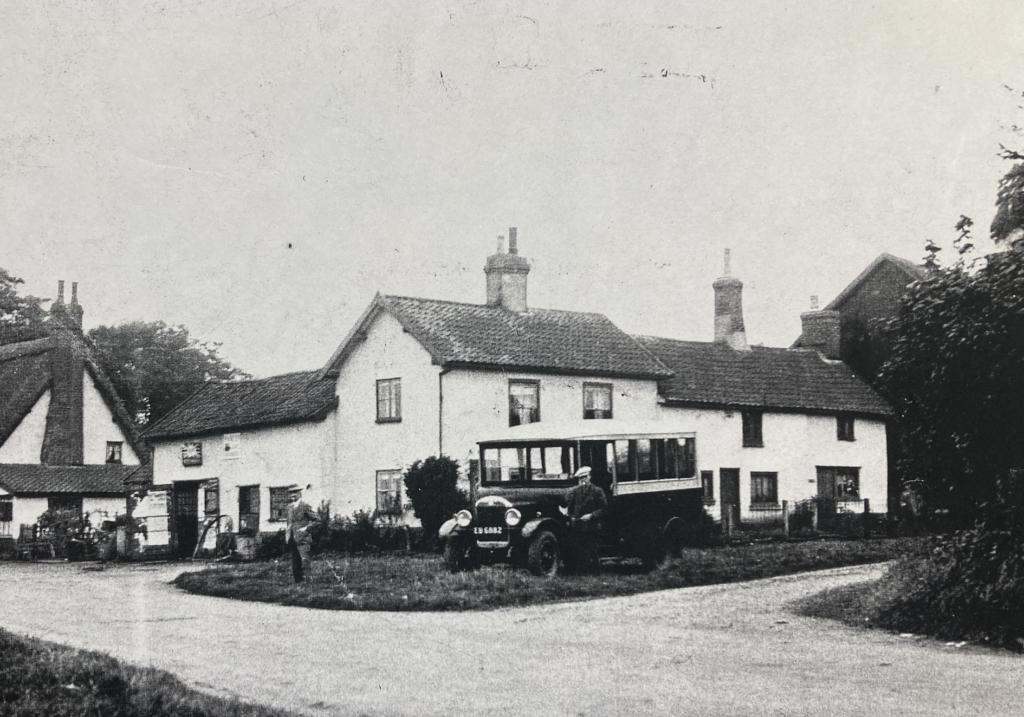
King’s Corner also known as Timberhill (junction of Church Street with the B1077)
Courtesy Jill Francis
Cox & Saunders
Adjoining the Blacksmith’s House is a cottage which was occupied by Mr. G Cox and his wife. Mr. Cox was a gardener at the Wayland Hospital. He had the misfortune of double hernias and other infirmities which made him into a crouched figure. I remember seeing his frail body swinging to and fro as he walked to and fro to work; still I suppose he was appreciative of the work.
Another small cottage exists next to Mr. Cox’s I cannot recall the name of the early occupier, but I believe Mrs. Saunders had a occupation which went back in the 20th century. She was informally known a Mrs. ‘Cambridge’ Saunders, which I believe refers more to her origins rather than any academic connections.
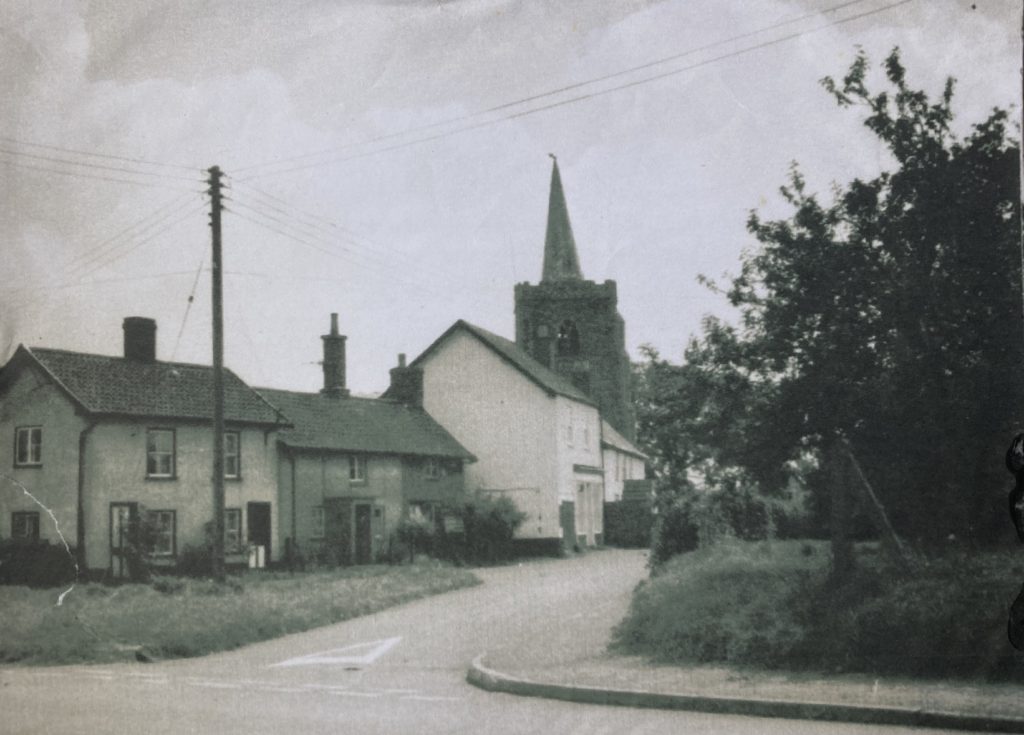
Cottages just into Church Street from the Attleborough Road. Date unknown
Courtesy Jill Francis
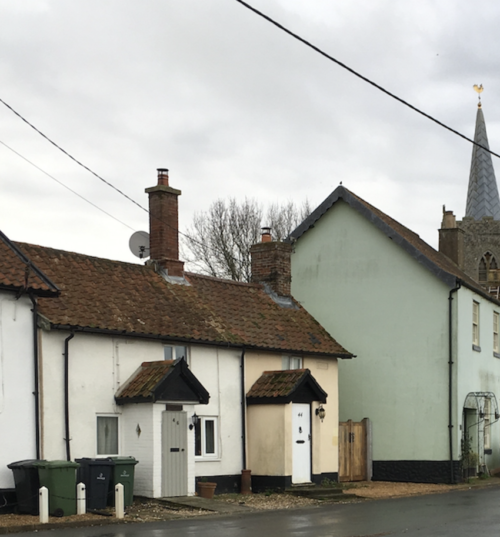
‘West View’ and the neighbouring cottage. Photograph taken February 2019
King
Next to Mrs. Saunders’ cottage is another cottage known a West View. This was first known to me to be occupied by Mr. Oliver King and his wife and then by the brother of Mr. O King, Mr. George King and his son. Both the King men were sons of Mr. Andrew King the blacksmith.
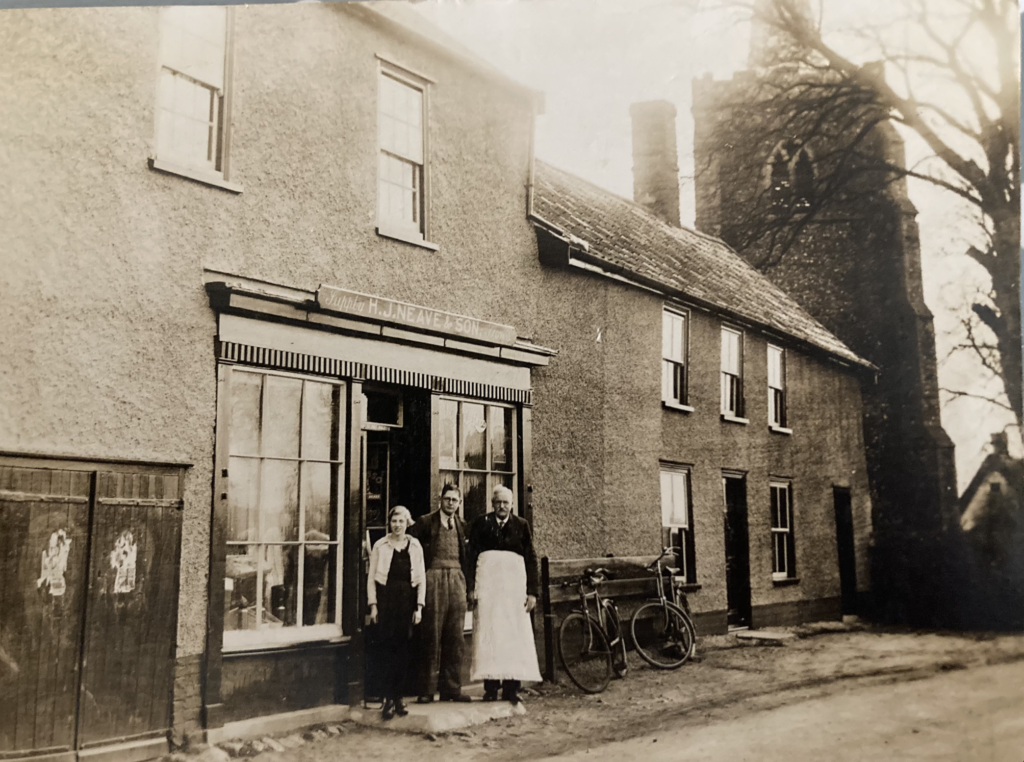
Raymond Neave (centre) with his father Joe (right) and possibly Ray’s step-sister Mary (left)
outside their Supply Stores and their adjacent home.
Courtesy Cindy & David Dove
Neave
Separated from Mr. King’s cottage by a small passageway which gave rear access to dwellings is Mr. H.J. Neaves’ shop, this was a general store with adjoining dwelling where Mr. & Mrs. Neave and their son Raymond lived.  Raymond in later life became a non-conformist minister.

The shop and dwelling are pantiled roofed with rendered walls.  Mr. Neaves’ property adjoined the village churchyard where St James’ Church is located.  The churchyard extends along the west side of its abutment with Church Street.
Neeve & Pollard
At the south end of the churchyard is a colour-washed and pantiled roofed shed which probably had been used as a coach house.
There was a passage between the coach house and the next building which was wide enough to allow carts to pass through. The next building being wattle and daub, with a pantiled roofed single story part at the south end. This building was occupied by two families.
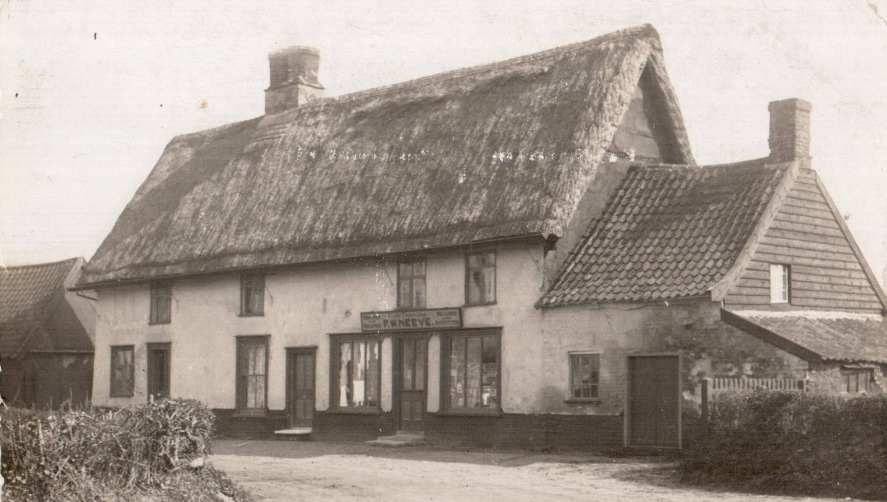
Neeve’s Shop in Church Street, later known as Ye Olde Thatche Shoppe. Note the building on the far left – referred to by Harry Rix as a former coach house. Single storey pantiled roof addition to the right. This was once used as a school room in the early 1800s.
Postcard Ewin Family
At the north end Mr. & Mrs. Neeve lived, although the Neeves pronounced their name similarly to the family at the shop on the north side of the church. They were not related as is shown by the variation in the spelling of the surnames.
The southern part of the building was occupied by Mr. & Mrs. Pollard and their son and daughter. It shows antique features of construction design.
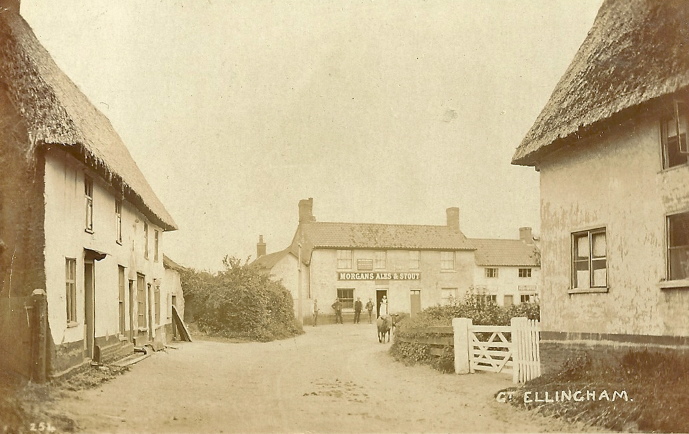
Crown Public House (with Morgans Ales & Stout signage) with adjoining premises of Frederick Key. Islay House (now Orchard Cottage) on the right right of the postcard
Courtesy Attleborough Heritage Group
Ayres
Following a bend in Church Street the Crown Public House is reached, with it’s landlord Mr. Charles Ayres who was assisted by his wife. The pub part of the building was owned by the brewers who were Morgans of Norwich.
Key
The adjoining building comprise a harness marker’s shop which bore the name Fred Key Harness Maker.  Mr. & Mrs. Key with their son and daughter lived in the house which was continuous with the harness makers shop.

Mr. Key did farm work as well as harness making.  He also cycles to work using a ladies cycle which he got on and off of in the same way as would have been done by a female.  His children felt this was not quite right for their father and to put things in order, tied a piece of string from the seat to the front of the frame to act as a crossbar.  Mr. Key got on the bike okay but by the time he had got to his destination, he had forgotten about the Mk II amendment and tried to dismount the old way – not to be recommended!
There was an access way for a cart to Church Street to the rear of My Key’s property, and a small shed sideways to the road next to the access.
Methodist Chapel
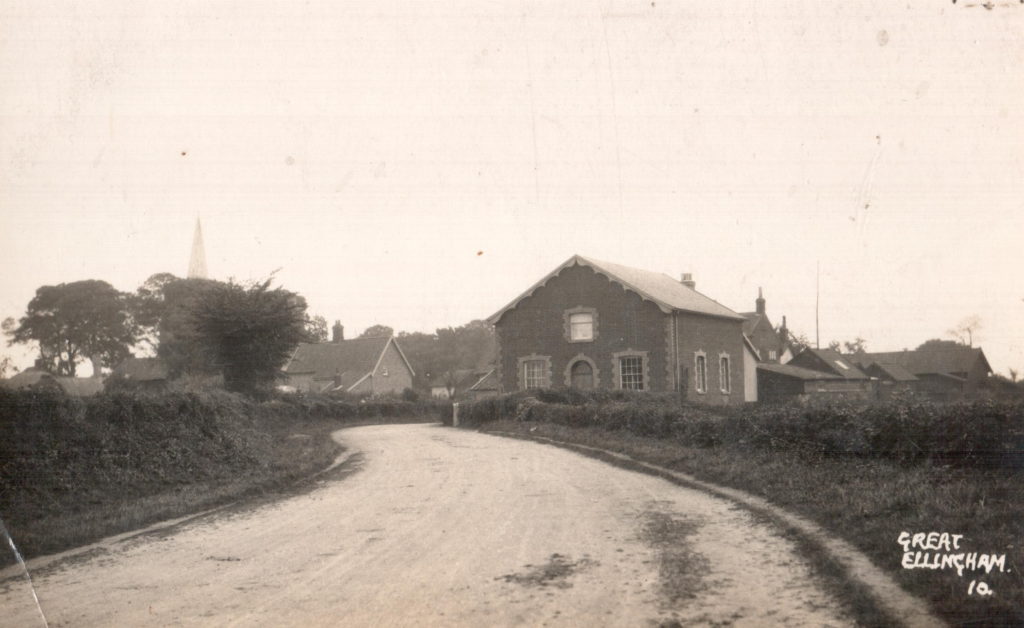
Church Street. Methodist Chapel.
Postcard Ewin Family
The next building was an outhouse which adjoined the Key's property, and was part of the Methodist Chapel property.
The chapel was of clay construction walls faced externally with red brickwork with a slate roof. There was also a lean to schoolroom.
Wigby
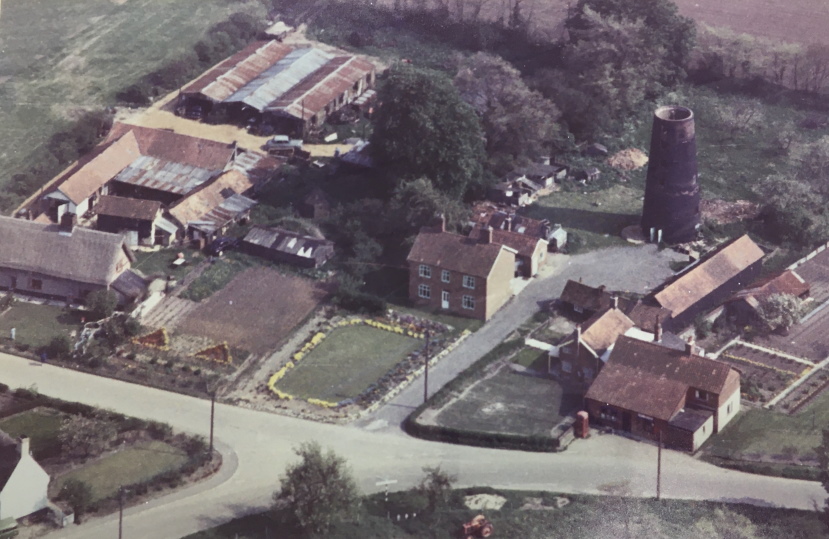
1965 From left, Mill Farmhouse, Mill House, the Mill, Mill Cottage and the Post Office premises
Courtesy Angela Campbell-Roberts
Further along Church Street from the Methodist Chapel, past a field and a pond, we reach Mill Farm. The Farmhouse is built with wattle and daub walls and thatched roof. It has a brick walled and tiled roof extension at the rear.
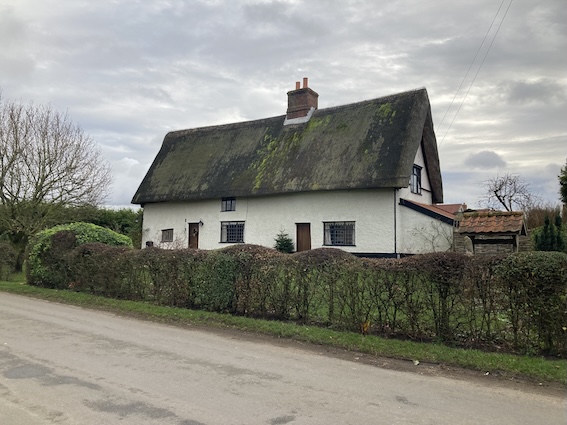
Mill Farmhouse. Photograph 25 December 2023
Mr. & Mrs. Obadiah Wigby and their four sons (Jack, Frank, James, Edward) and a daughter lived at Mill Farm. Mr. Wigby farmed land in parts of the village and kept dairy cows. He was one of the few people who had a car, a two seater with a boot that had a hinged lift-up lid which, when in the up position, provided seating for passengers.
As well as being a farmer Mr. Wigby was skilled in carpentry and built a wagonette for taking his children out for walks. The story goes that on one Sunday visiting his friends, it came on to rain at going home time so he put his wife in the carriage with the children, and pushed them all home.
Breeze
Leaving the Mill Farm a few yards of garden bring us to the Mill House. The house and its bake office are built in fletton bricks and have red tile roofs. It is believed that a fire may have destroyed the earlier bakery premises.
There is some uncertainty about who was the baker in bygone times, probably a Mr. Breeze.
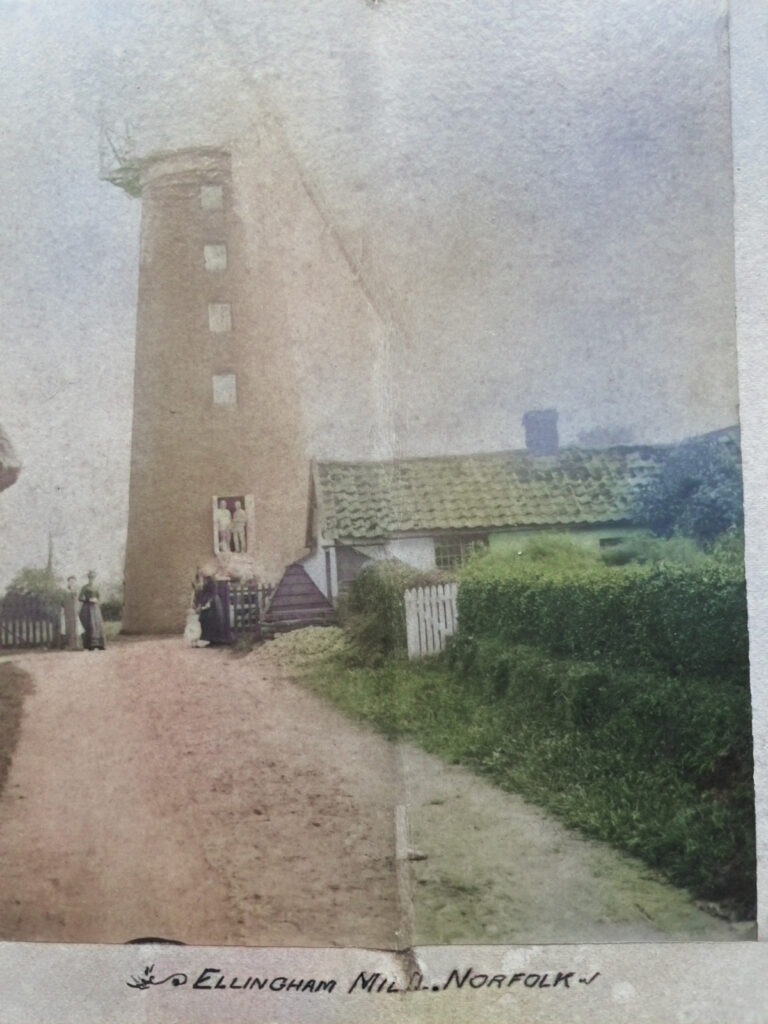
Great Ellingham Mill. Courtesy Joan Barnard
There are several outhouses and a brick built tarred-wall mill. I remember the mill having part of a white boarded cap and sails. It also had a fan wheel which had a long continuous chain. This chain operated the fan wheel for altering the aspect of the main sails when only a very minimal amount of wind blew.
Storey
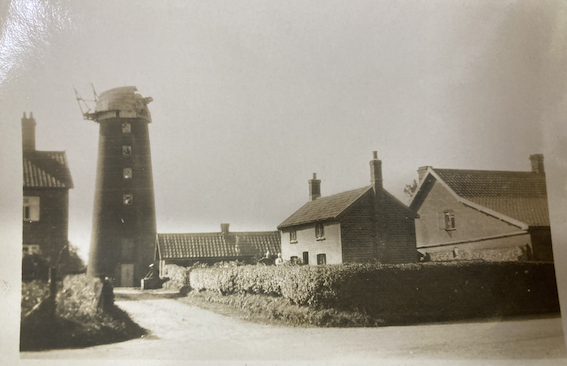
Sideways to the road is the small brick & tile cottage once occupied by Mr & Mrs Storey. Courtesy Angela Campbell-Roberts
At the side of the access track to the mill is a small brick and tile cottage. This was occupied by Mr. & Mrs. Storey and their family.
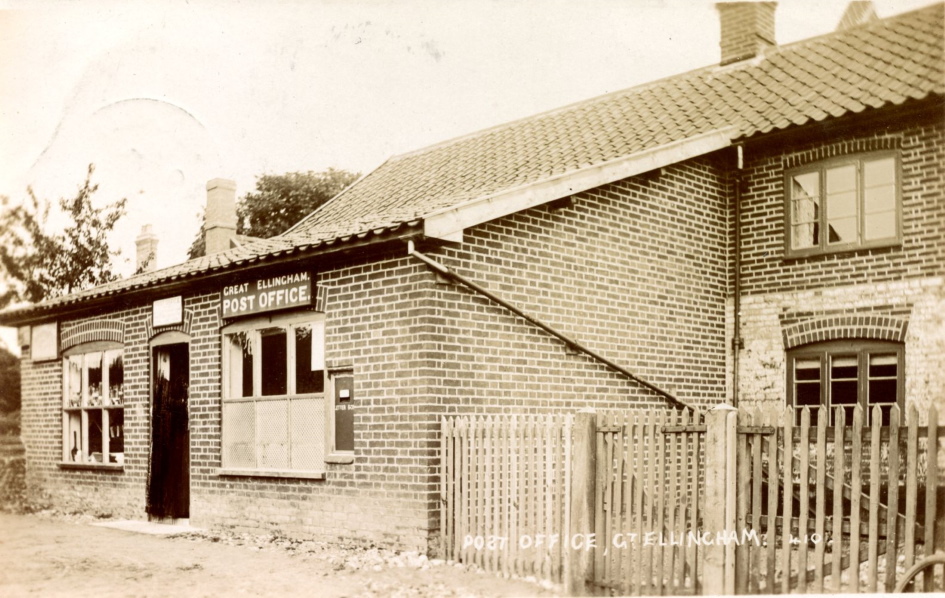
Great Ellingham Post Office. c.1907
Wilkins
Next to the cottage the Post Office and postmaster’s residence was located, and has been in the same place for more than a century.

The post mistress was Miss Anne Marie Wilkins who lived in the post office house with her sister Miss Elvina Wilkins.
Mail deliveries came to the Post Office in the very early morning on weekdays and were sorted and delivered to Great & Little Ellingham by men on bicycles. This seemed to work well.
I know of one dealer who lived at Little Ellingham who had a copy of the Eastern Daily Press send by post daily from Norwich so that he would have early notification of sales of farming goods etc and, being a dealer, he would be one step ahead of his competitors who got their information from newspapers which were delivered by the newspaper boy. A case of 'the early bird and catching the worm'!
A corrugated iron shed stood on the post office orchard. This housed a motor van and was used by the carrier to make journeys to and from Norwich. His parking place in Norwich was Coburg Street(alongside what was Caley’s factory). He would take goods to Norwich or bring goods from Norwich on behalf of clients. Often shops in Norwich (if requested) would arrange for customers’ purchases to be taken to the carriers van.
Jude
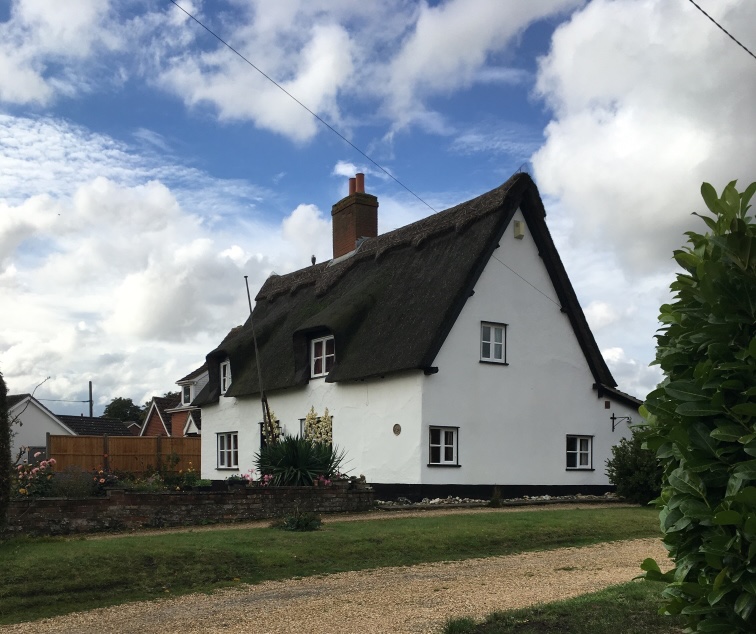
Church Farmhouse. Photograph 2022
Returning to the Blacksmith’s House and crossing over Church Street, we come to Church Farmhouse. This has wattle and daub walls and reed thatched roof. Mr. George Jude lived here on his own, and owned some of the land from which he was able to get some kind of a living. He was one of 3 brothers who lived in the village.
At one time village men wanted to play bowls and worked hard to make George Jude’s stackyard into a bowling green.
Reynolds
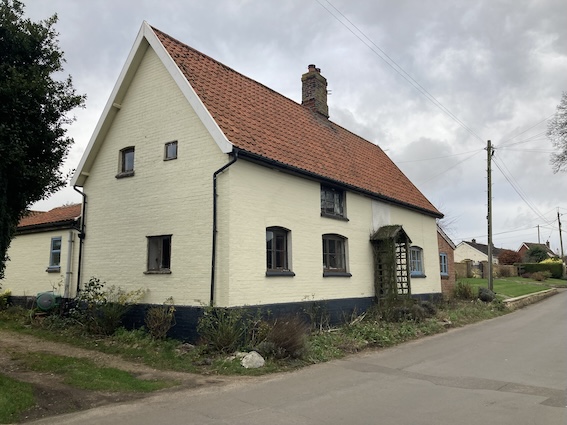
Orchard Cottage formerly Islay House. Photograph 25 December 2023
Continuing on down Church Street on the same side we come to Islay House the home of Mr. William Reynolds and his wife. Mr. Reynolds was engaged in veterinary work and had the reputation of having a liking for the juice of the barley, or was it in the distilled form from Scotland? His affinity for Scotland could perhaps be explained by his second forename, Buchan.
He was reputed to like to have a drink in the public house at Caston. On one occasion his wife feeling that he had gone off in that direction set off to meet him as he returned home. Having reached Caston hill she heard his horse’s hooves galloping on the road, and as the horse and high cart came into sight she waved her arms and called out “William, William”. To which he replied “I don’t stop for strange women on the road madam”, or so the story goes! His reputation as a vet was good, one local person told me how William (after a heavy day), was called to a farm at Hardingham, and diagnosed the trouble as soon as he saw the beast.
Hitchman & Lincoln

Church Street Cottages. Note the former ’tiled roofed sheds’ on the far left. Photograph taken December 2023
Across Church Street from Mill Farmhouse there were some clay-walled and tiled roofed sheds, and a terrace of clay walled thatched roofed cottages. The first cottage was occupied by Mr. Hitchman and his wife and family who came from London for a comparatively short stay. Mr. Hitchman operated a greengrocer’s business.
In the next house Mr. “Drummer” Lincoln and his wife lived. Mr. Lincoln suffered from severe form of rheumatism.
There was also another dwelling which has now been incorporated in to the other dwellings.
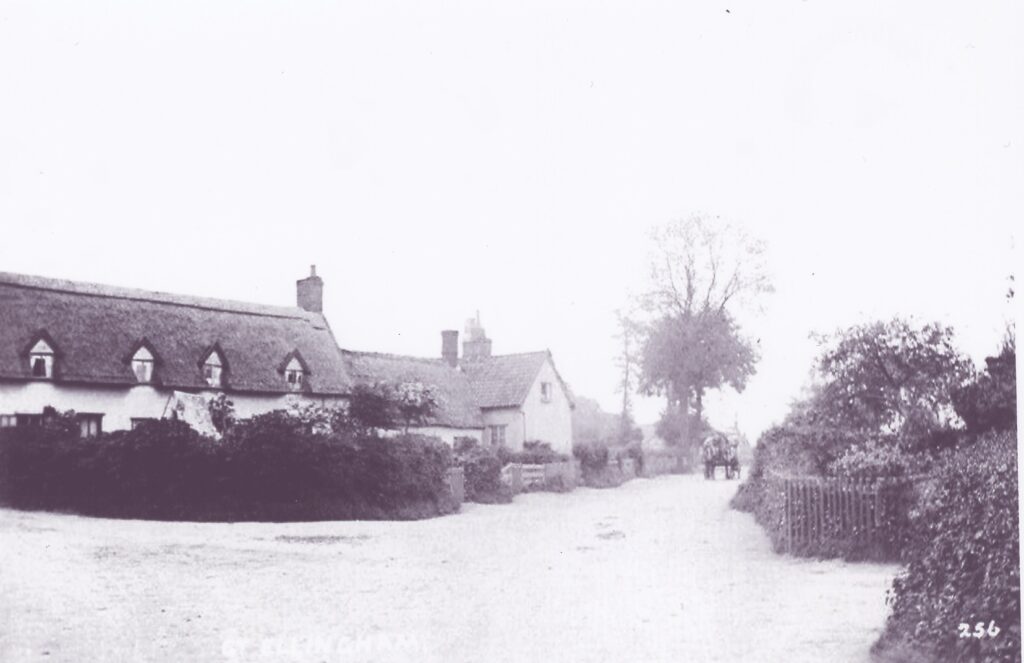
Church Street. Date of postcard unknown. Note the ‘end dwelling’ sideways to the road.
Coldwell
The end dwelling was occupied by a husband and wife who came from the Isle of White. On their front garden gate they had a sign which stated “William Coldwell late of Osborne House Isle of White Gentlemen’s Hairdresser”. Mr. Coldwell had in addition to his tonsorial skill one other attribute which was a powerful tenor voice, which he liked to exercise at services in the village church.
Ryder & Reeder
Another pair of dwellings at the end of the thatched terrace stood end ways to Church Street. These had clay walls and tiled roof. One dwelling was occupied by Emily Ryder. The dwelling nearer Church Street was occupied by a retired farm worker and his wife, Mr. & Mrs. Joe Reeder.
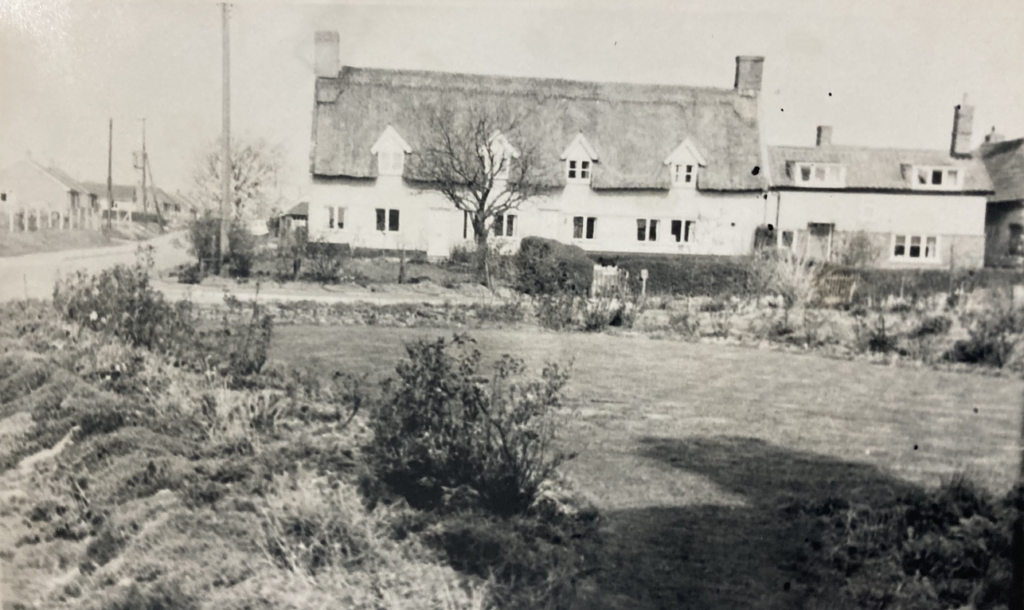
View of cottages in Church Street near junction with Chequers Lane/Long Street.
A small dwelling/shop once adjoined the cottage on the far left but has since been demolished
Photograph taken from Mill House. Courtesy Barbara Scase
Hudson & Bilverstone
Continuing along from the Reeder’s cottage was a small colour-washed wall and tiled roof cottage occupied by retired farmer Mr. Oakely and his wife. This cottage adjoins a substantial pair of colour-washed walled and thatched roofed cottages occupied by Mr. and Mrs. Hudson and their family in the east cottage and Mr. & Mrs. Bilverstone and their family in the west part.
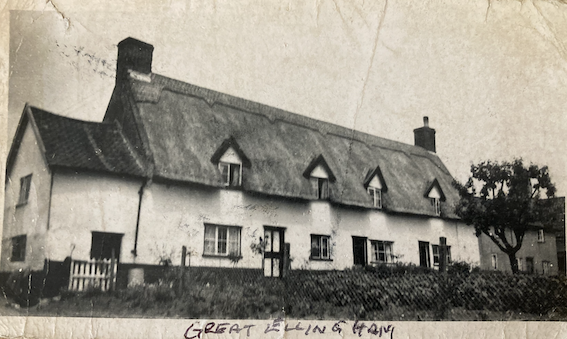
Cottages in Church Street near to the junction with Chequers Lane. Note the small cottage/shop on the far left which was once occupied by Mr Warren. The cottage/shop has since been demolished.
Courtesy Paul Hawkins
Warren
A small dwelling adjoined the west cottage and was occupied by Mr. Warren who had a model horse and cart in full harness displayed in his window, an item much admired by schoolboys as they passed along the adjacent Chequers Lane.
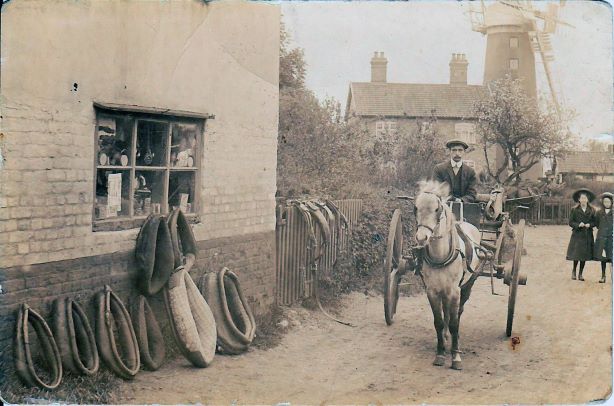
Corner of Chequers Lane and Church Street. The Mill in the background and Warren’s harness maker’s shop on the left. Mill, Mill House & Mill Cottage in the background
Postcard Christine Bell
In other articles, Harry Rix takes us along Attleborough Road, Chequers Lane and Long Street.
Source:
‘Early Boyhood Recollections of a Great Ellingham by an Octogenarian’ Harry Rix. Huge thanks to Elizabeth Neil.